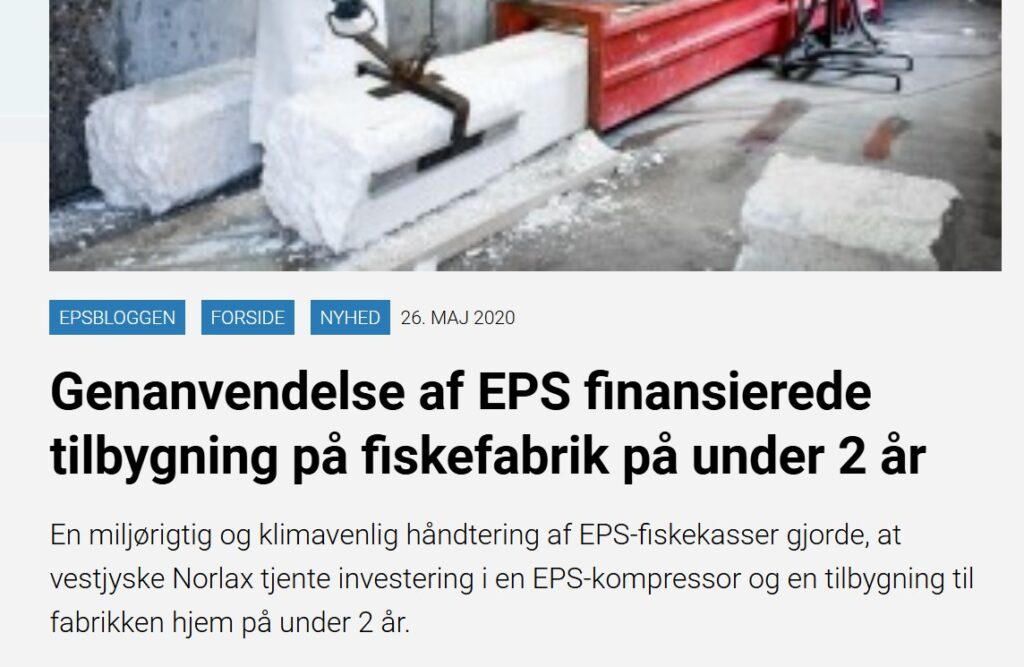
In the Danish town of Outrup, fish processor Norlax A/S has shown how structured EPS recycling can deliver tangible financial returns. By installing a RUNI SK370 compactor, the company managed its growing volume of EPS fish boxes more efficiently—cutting transport costs, generating recyclate revenue, and ultimately financing a facility expansion in under two years.
A common problem with an uncommon outcome
Norlax handles thousands of EPS fish boxes every week. Like many seafood processors, it faced rising costs from handling, storing, and shipping this bulky but lightweight material. In response, it implemented an onsite densification system: a RUNI SK370 that compresses expanded polystyrene by up to 40 times its original volume.
Once compacted, the dense EPS blocks were stored on pallets and sold as raw material. The value from this waste stream was not theoretical—over time, it paid off. Norlax directed the profits to expand its facility, adding new production space without requiring external capital for the build.
The system behind the results
The EPS recycling system at Norlax is simple but efficient:
- Used EPS fish boxes are compacted directly on-site.
- The RUNI SK370 compresses EPS into 250–350 kg/m³ ingots.
- These are palletised and sold to approved recyclers.
- Transport volume is reduced by more than 90%.
- No water is used in the process, and only one operator is needed.
This closed on-site loop limits both emissions from unnecessary logistics and the financial outlay required for traditional waste handling. It also insulates Norlax from volatility in waste handling fees.
Strategic relevance
This is more than a facility-level success—it is a clear proof of concept that decentralised EPS densification can generate positive returns. While EPS waste is often seen as a liability due to its volume and low density, Norlax’s approach demonstrates the opposite: with proper equipment and consistent flows, it becomes a profitable raw material.
It also reinforces the case for direct recycling investment by private businesses. Many producers rely on external service providers for material disposal. By investing in densification infrastructure and integrating it into daily operations, companies like Norlax create internal value from a formerly external cost centre.
For municipalities and industry stakeholders alike, this case offers a model for how EPS recycling can be embedded directly at the source of consumption and reuse—not only saving cost, but enabling reinvestment.
FACT BOX
| Item | Value |
| Launch | Approx. 2018 |
| Location | Outrup, Denmark |
| Facility | Norlax A/S seafood processing plant |
| Equipment | RUNI SK370 EPS compactor |
| System model | Onsite densification and sale of compressed EPS |
| Volume reduction | Up to 40:1 |
| Payback period | Under 2 years (equipment financed new facility wing) |
| Outcome | Reduced logistics costs, internal revenue stream from EPS recyclate |
Source: “Genanvendelse af EPS finansierede tilbygning på fiskefabrik på under 2 år,” EPS-Airpop (May 2020)
https://eps-airpop.dk/2020/05/genanvendelse-af-eps-finansierede-tilbygning-paa-fiskefabrik-paa-under-2-aar