Function with Awareness. Performance with Responsibility.
EPS’ material impacts — in context of its role
Every material has an environmental footprint. What defines value is what it delivers — and how it performs in context. EPS is used not for its novelty – often it is hidden from the public eye when in use. EPS is chosen for its ability to do more with less: insulating buildings with minimal mass, protecting goods in long-distance logistics, and contributing to stable systems with defined environmental benefit.
Across the Nordic region, EPS supports reduced energy loss, lower transport waste, and reliable protection in long-use or risk-sensitive applications. But performance alone isn’t enough. EPS must also be used — and improved — with responsibility in mind.
This section outlines four areas where EPS aligns environmental performance with material function.
High Function, Low Input
Efficiency that starts with design
EPS consists of 2% polystyrene and 98% air – and as a monomaterial 100% recyclable. This ratio allows high thermal and mechanical performance with minimal material use. That low input translates to:
- Lower embodied emissions in insulation systems
- Reduced transport fuel in protective and cold-chain packaging
- Fewer components and simplified logistics in integrated designs
Its simplicity — both structurally and in application — supports lifecycle efficiency: less material, fewer layers, and performance over time without constant intervention. See our fact sheets, technical briefs and other publications for more on EPS applications.
Read High Function, Low Input for more information and case studies.
Climate Impact in Context
Environmental benefit isn’t just what’s emitted — it’s what’s avoided
EPS has a carbon footprint — but in many cases, it prevents far more emissions than it creates. Used in building insulation, it can reduce heating and cooling energy over decades. In packaging, it protects goods whose replacement would carry significantly higher carbon costs.
EPS climate value must be assessed in full system context:
- Avoided food loss in distribution
- Energy savings over a building’s lifespan
- Lightweight transport contributions to fuel efficiency
What matters is not just the footprint — but the function behind it. Read our fact sheets on EPS LCA’s and more in our download section.
Read Climate Impact in Context for more information and case studies.
Beyond Carbon
A full profile — not a single metric
Carbon is important — but not the only environmental lens. EPS also contributes through:
- Preventing spoilage and breakage in long-haul transport
- Providing insulation in low-resource buildings or remote geographies
- Remaining inert in landfill — without leaching or breakdown byproducts
EPS is a stable and inert material, with limited interaction with soil or water when managed in controlled end-of-life scenarios. Its environmental impact should be assessed based on actual persistence, exposure potential, and containment — not assumptions of degradation or visibility alone. Recycling and secondary energy recovery are the preferred end-of-life routes, consistent with the waste hierarchy. No material should be littered or released into the environment. For further data on EPS and its environmental profile, including marine litter, see our fact sheets.
Read Beyond Carbon for more information and case studies.
Circularity, Reuse, and Recovery
A system under evolution — and under implementation
EPS is 100% recyclable when collected properly. In the Nordic region, infrastructure for clean sorting, collection, and recovery is increasingly established — from municipal schemes to company driven take-back and even some cases of reusable applications in manufacturing.
Circularity is supported by:
- Monomaterial composition
- Consistent formats
- Recovery logic aligned with logistics and building workflows
In our download section you can find reports and analysis on EPS in the Circular Economy.
Read Circularity, Reuse, and Recovery for more information and case studies.
Environmental Performance — when used where it works
EPS does not claim universal sustainability. But in defined roles — long-use insulation, transport protection, stable infrastructure support — it offers clear environmental value:
- When it delivers efficiency with minimal input
- When it is proven to perform across long lifecycles
- When it is securely integrated into recoverable, compliant systems
EPS supports environmental goals when it works as intended — not everywhere, but where it matters most.
Litter and EPS – Addressing Misperception and Responsibility
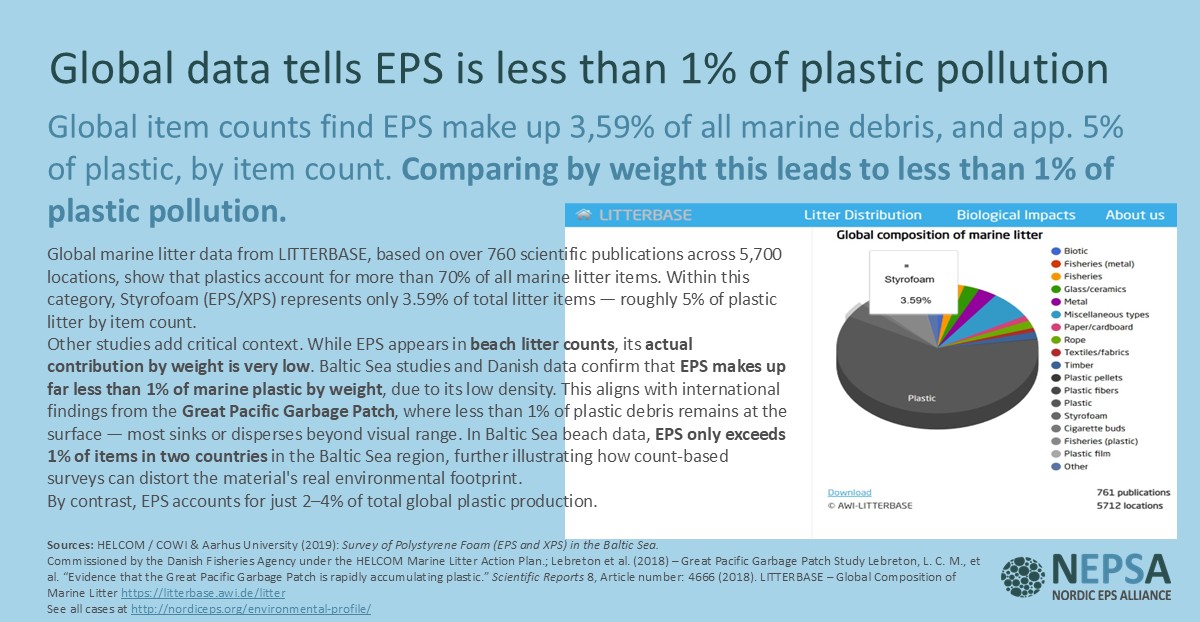
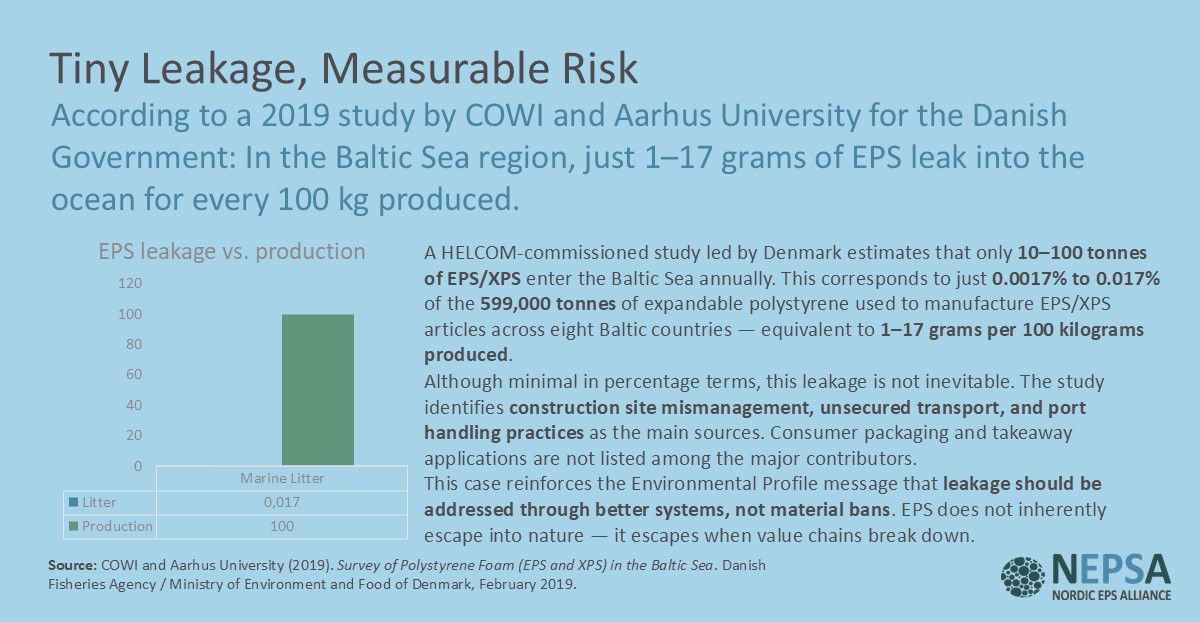
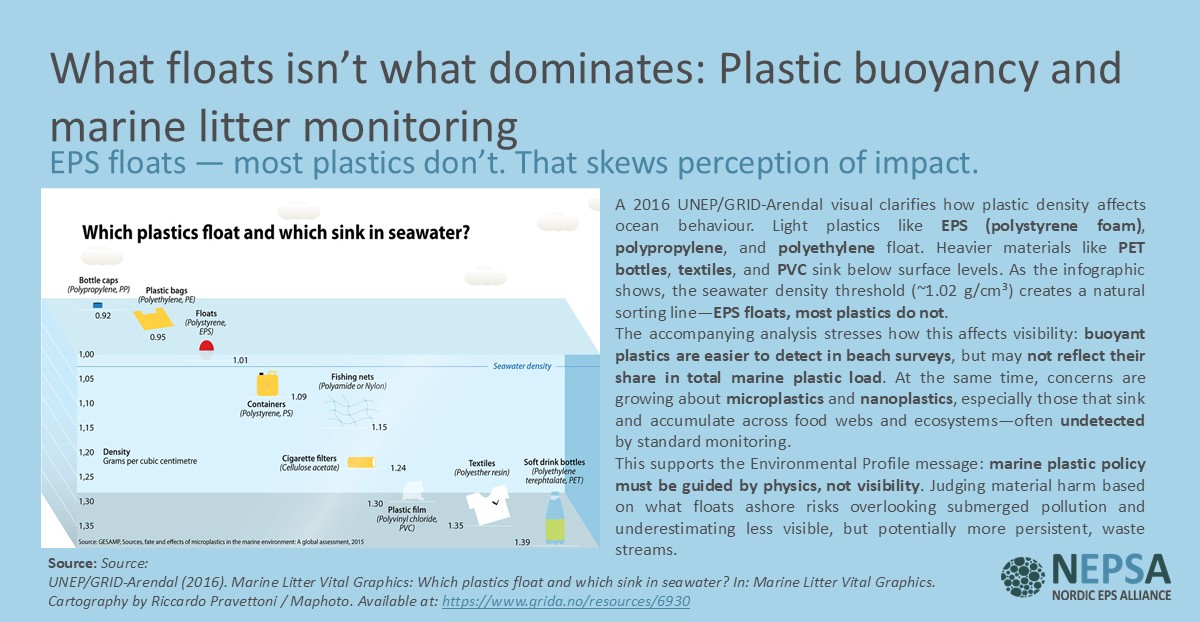
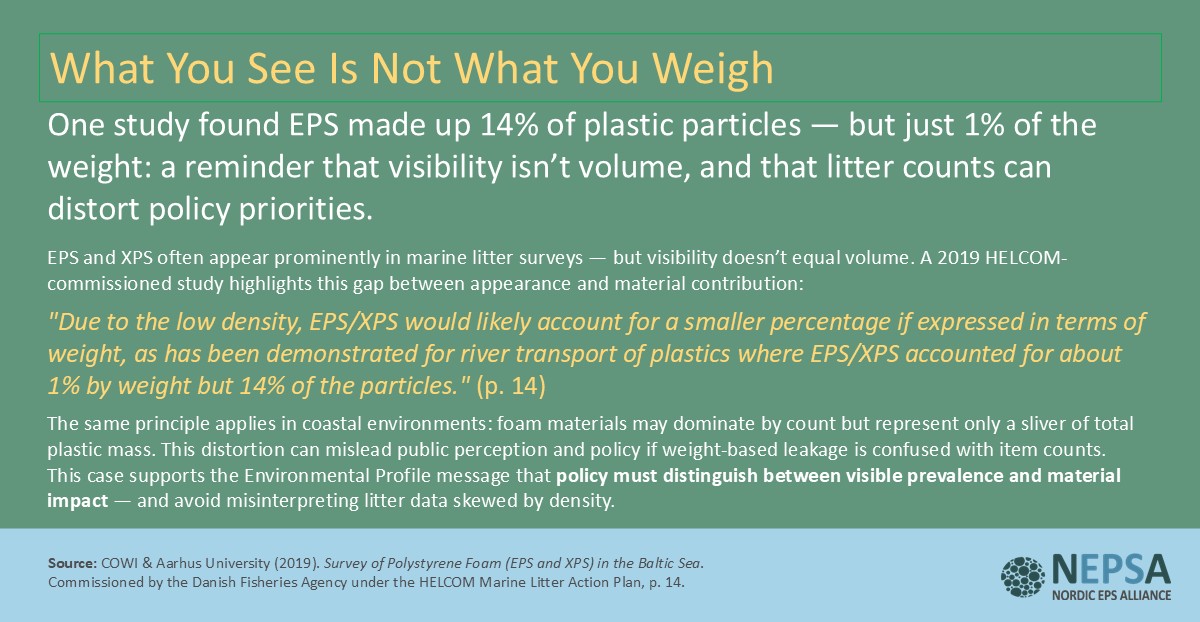
Litter is not an environmental impact category in itself, but it is a visible and emotionally charged issue — and part of any material’s environmental profile. EPS is sometimes associated with litter, particularly marine litter, due to its lightweight structure and white appearance. This visibility can create a misleading impression of volume or impact.
There should be no doubt: EPS, like all materials, should never end up as litter. Proper end-of-life handling is essential — ideally through recycling, which is increasingly the norm across the Nordic region. Still, the presence of EPS in litter data, policy discussions, and public perception means it must be addressed with both honesty and clarity.
This section presents what the data shows about EPS in litter — including offshore and shoreline observations — and explains how metrics like weight vs. item count, buoyancy, and collection system design shape our understanding of the issue.