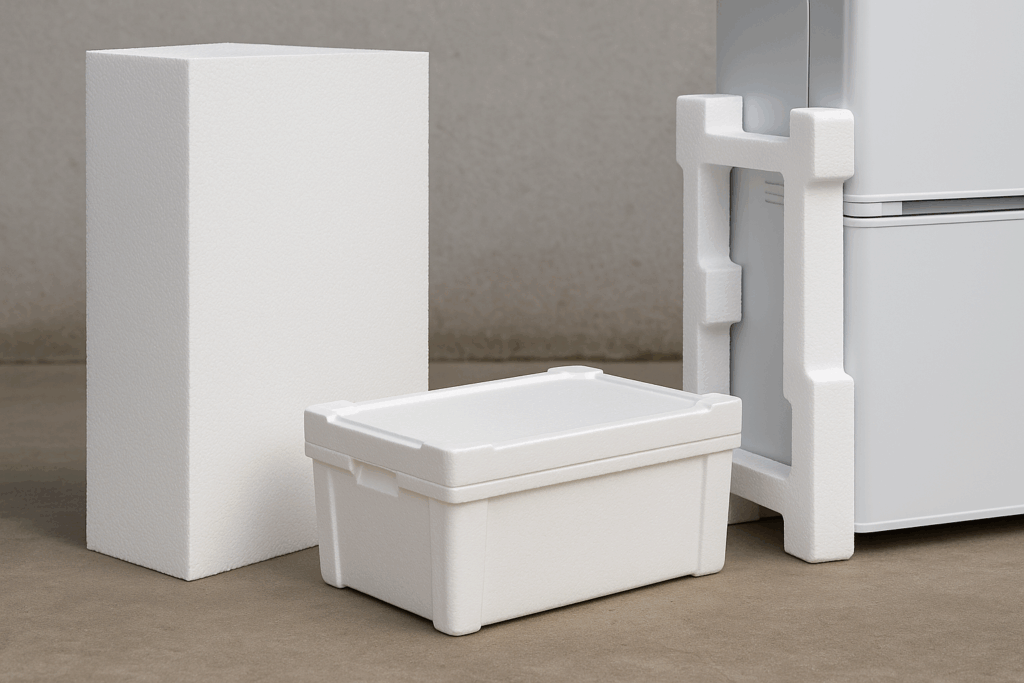

The U.S. Plastics Pact has removed expanded polystyrene transport packaging from its Problematic & Unnecessary Materials List after reviewing evidence of recycling at scale.
It is the first packaging format to be removed from the list since its establishment. The decision applies specifically to moulded EPS transport packaging used to protect durable goods, temperature-sensitive products and fragile items during handling, storage and transportation.
It does not apply to EPS or polystyrene as a whole. Other applications, including foodservice packaging, remain on the U.S. Plastics Pact list.
Recycling rate reaches approximately 31%
According to reporting by Packaging World, available data indicate a North American recycling rate of approximately 31% for EPS transport packaging. This was sufficient to meet the first criterion in the U.S. Plastics Pact’s assessment framework: whether packaging is reusable, recyclable or compostable now, or is expected to become so by 2030.
The U.S. Plastics Pact concluded that the evidence demonstrates that EPS transport packaging is recyclable today.
Unlike many forms of household packaging, much EPS transport packaging moves through commercial distribution systems. This creates opportunities to collect clean and relatively consistent material from warehouses, distribution centres and other concentrated sources. Consumer packaging may also be collected through drop-off points and other routes outside conventional kerbside systems.
Collection needs viable end markets
The decision is based on more than the existence of recycling technology. The U.S. Plastics Pact highlights the development of end-market demand for recycled EPS alongside increased collection.
This balance is essential. Collecting more material does not in itself create circularity if there is no economically viable use for the recycled raw material. Demand for recycled content creates value, while densification helps address the cost of transporting a material that consists largely of air.
These are important lessons beyond the United States. Successful recycling systems require coordinated development of collection, preparation, transport, recycling capacity and markets for the resulting material.
Assess applications on their evidence
The decision also illustrates why packaging assessments should distinguish between different applications of the same polymer.
EPS transport packaging has particular functions and recovery routes. It protects products against impact and temperature changes, often reducing product damage and loss. Its environmental performance therefore cannot be assessed solely from the material name or from the collection system used for unrelated EPS applications.
NEPSA welcomes the principle that classifications can be reconsidered when new data demonstrate changed outcomes. There is still work to do to increase recycling rates and expand access to collection. Removal from the list should therefore be understood as recognition of measurable progress, not as an indication that the development of circular systems is complete.
Good policy depends on clear definitions, application-specific evidence and a willingness to update conclusions when the facts change.
Sources: U.S. Plastics Pact statement and Packaging World.