EPS in systems designed to reduce waste and extend value
Expanded Polystyrene (EPS) is sometimes misjudged by appearance — and assumed to be incompatible with circular goals. This is largely a legacy of outdated conditions: consumer and household recycling of EPS did not begin at scale until recently, and early challenges continue to shape perception.
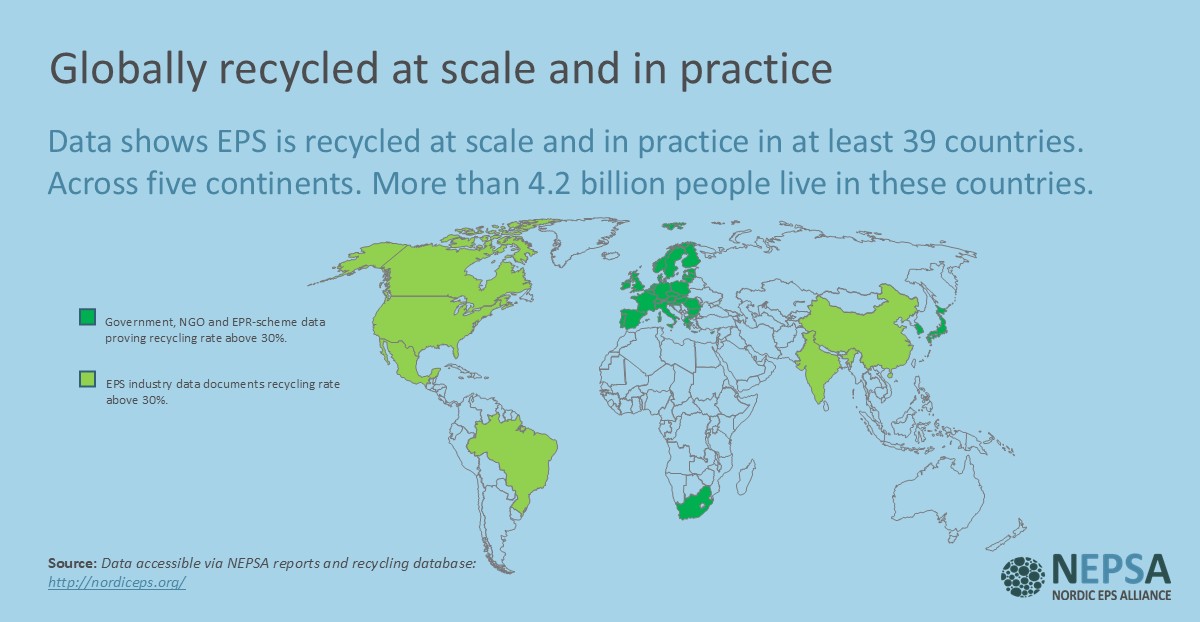
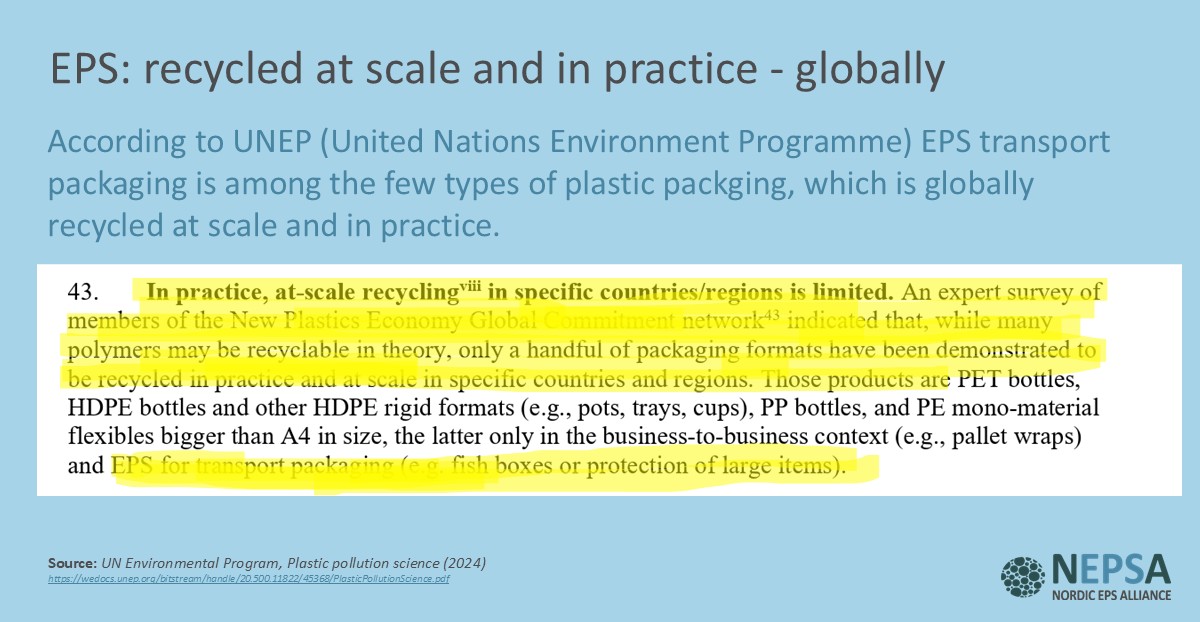
But the reality is shifting. In commercial flows, industrial systems, and public infrastructure, EPS is already being recovered, recycled, and — in specific applications — reused. It is not circular by default, but it is circular in practice when the system is designed accordingly. In fact, UNEP has recognised transport packaging in EPS as recycled at scale and in practice globally.
Circularity is a system, not a material
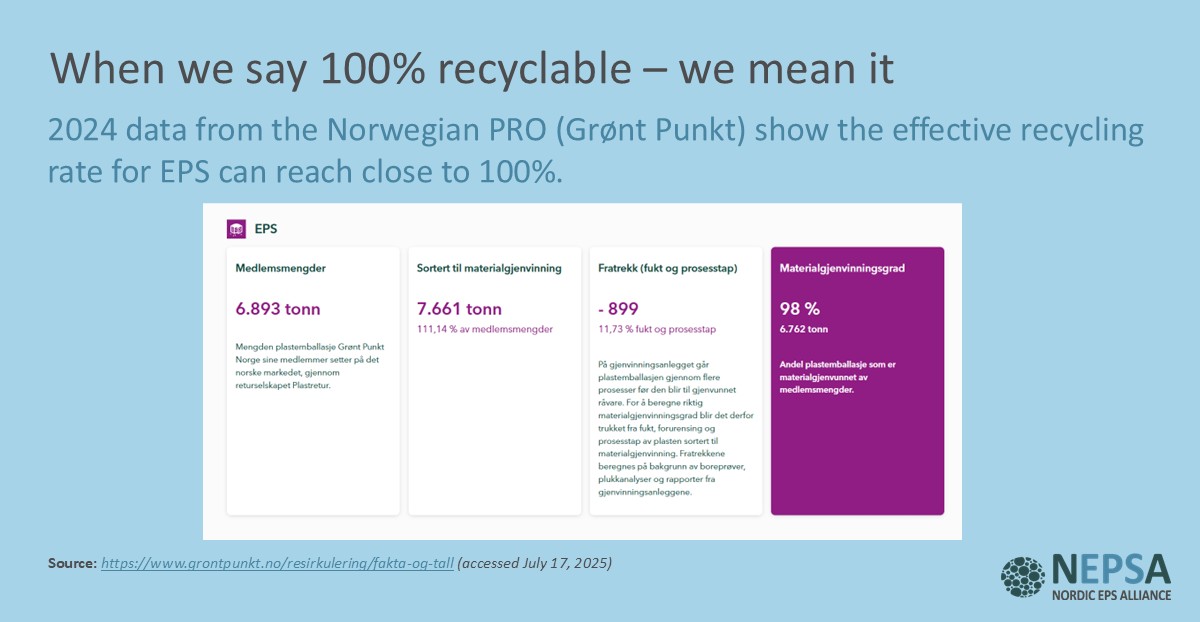
Circular performance is not a fixed material trait — it depends on design, use, and infrastructure. EPS is 100% recyclable and increasingly recycled, through both mechanical and chemical processes. What enables circularity is not just what the material can do, but what the system allows it to do.
EPS performs well in this context because it:
- Is monomaterial and easy to separate
- Maintains its properties through multiple cycles
- Requires no separation from coatings, binders, or composites
- Is light, clean, and stable in collection and processing
When waste streams are properly structured, EPS can become a high-value input to new material flows.
Reuse and return in controlled applications
While most EPS is used in formats that are not suited for reuse (e.g. long-distance shipping of goods or long-term building installations), controlled flows do allow reuse — especially in retail and local logistics. Examples include:
- Retail thermal boxes: e.g. for grocery delivery systems such as BilkaToGo and Nemlig in Denmark
- Fish transport: reuse may occur in regional circuits, though most volumes are recycled
- Construction: while EPS remains in buildings for decades, clean off-cuts are commonly segregated for reintegration in new EPS
Reuse is not the dominant strategy — nor should it be in high-dispersion or long-distance flows. But where reuse is feasible, EPS is structurally well-suited to repeated use without loss of function.
Collection and recycling performance
Across the Nordic region, EPS packaging and construction materials are increasingly being recovered — at rates that rival or exceed many alternative materials.
- In Denmark, over 60% of municipalities offer EPS drop-off points for households
- In Sweden, the “Site Zero” facility ensures packaging EPS is recovered from households via curbside sorting
- In Norway, PRO systems like Grønt Punkt Norge report recovery rates above 80% for commercial EPS packaging streams (verify)
These rates are supported by national EPR frameworks and growing municipal infrastructure, with clear collection paths for both consumers and businesses.
How EPS is recycled
EPS is compatible with several recycling processes:
- Mechanical recycling: clean EPS is compacted, pelletised, and reprocessed into insulation, packaging, or new goods
- Solvent-based dissolution: EPS is safely dissolved, separated, and reformed without degradation
- Depolymerisation: advanced processes allow EPS to be broken down into monomers and re-polymerised as virgin-equivalent polystyrene
Each method supports different material loops — and together they create a flexible recovery platform that can be scaled with investment and regulation.
EPS in circular systems
| Latest Recycling Cases | NEPSA continually compiles editorially sourced case studies and news articles on real-world EPS recycling and reuse. These examples are shared to inform system design, support evidence-based policymaking, and inspire practical implementation. The three most recent cases are shown to the left. You can see the full library of EPS recycling cases here. |
EPS does not achieve circularity in isolation — but in structured systems, it supports circular outcomes. It is clean, consistent, and recoverable, and its flows can be effectively managed across packaging, logistics, and construction.
Where reuse is possible, EPS delivers repeated value without structural loss. Where recycling is the right end-of-life path, EPS performs efficiently — with high capture rates and a range of viable reprocessing methods.
Circularity is not a promise. It is a system outcome. In this role, EPS earns its place — not as an ideal, but as a material that performs, returns, and reduces waste when infrastructure and design support its use.