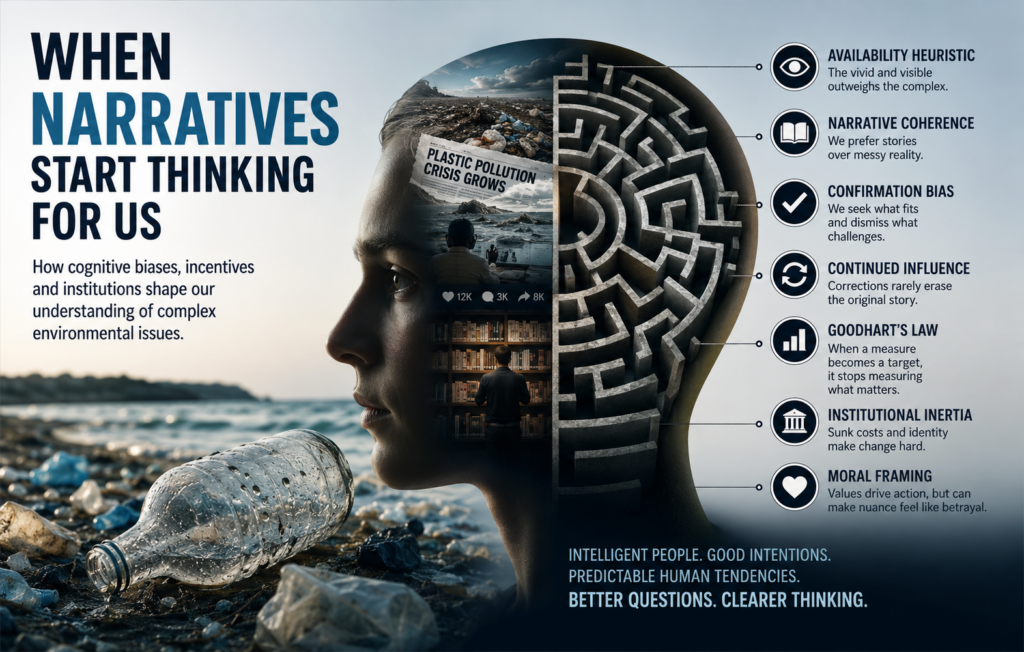
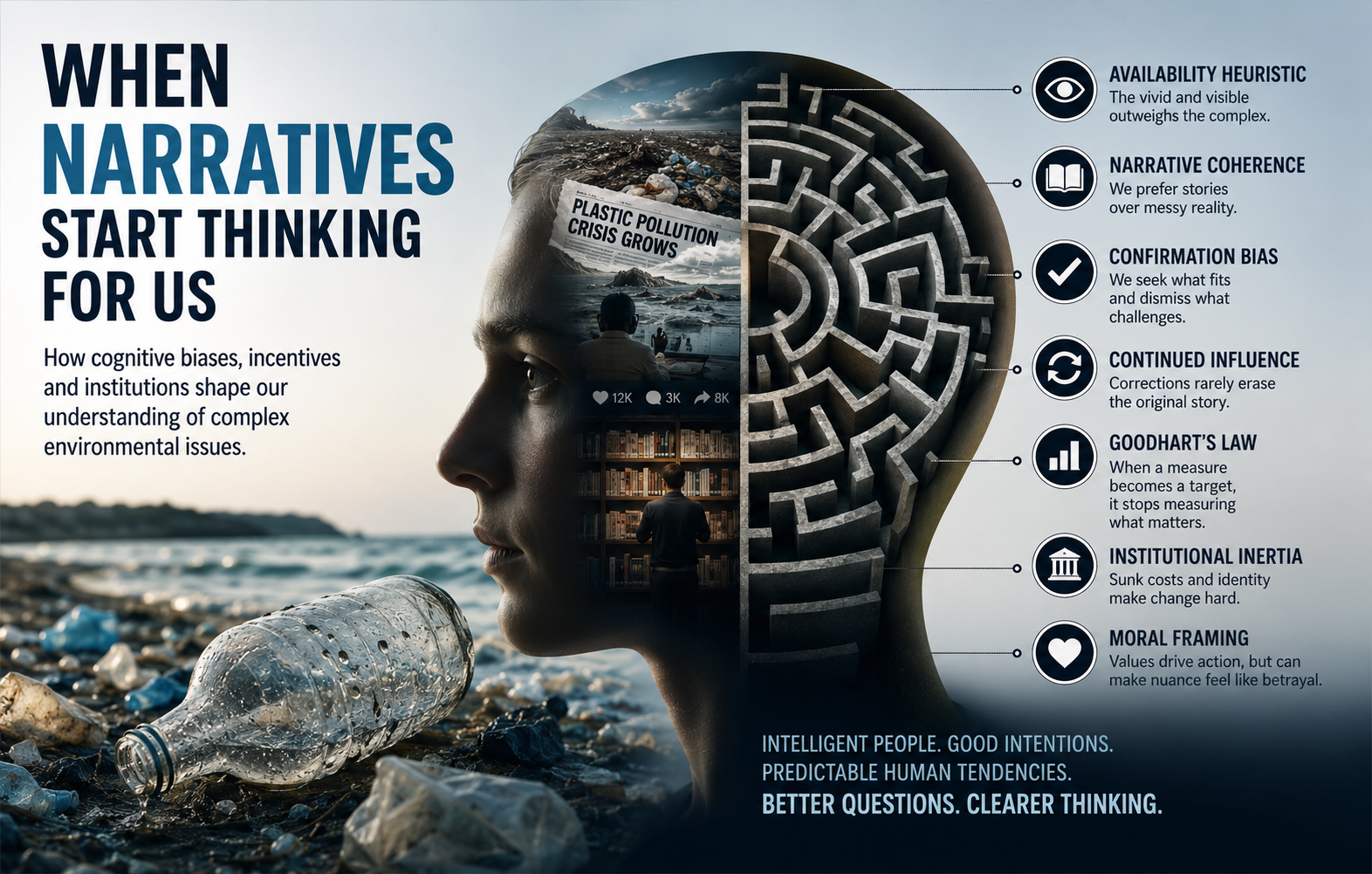
How do scientific findings become public narratives? And why can those narratives become surprisingly difficult to change, even when new evidence emerges?
These are the questions explored in the latest edition of Beyond Fast and Easy Answers, written by NEPSA Director Chresten Heide-Anderson.
The article builds on the previous newsletter, which examined a bottle-tracking study from North Carolina alongside a systematic review of how research on plastics and microplastics is communicated through science, media and public debate. Together, the two publications raised an important question: how do complex scientific findings evolve into widely accepted public narratives?
Rather than focusing on whether one particular study is right or wrong, the new article examines the broader processes that influence how evidence is understood and communicated.
It explores several well-established concepts from psychology and behavioural science, including the availability heuristic, confirmation bias, the continued influence effect, publication bias, sunk costs and escalation of commitment. It also considers how institutional incentives and communication practices can influence which findings receive attention and how they are interpreted over time.
A central message is that these mechanisms are not unique to any particular group. Researchers, journalists, policymakers, NGOs, industry representatives and the public are all subject to the same fundamental characteristics of human cognition. The challenge is therefore not simply to identify bias in others, but to recognise how narratives are created, reinforced and, when necessary, revised.
The article concludes that robust environmental policy depends not only on good science, but also on understanding how scientific knowledge moves through communication systems before it reaches decision-makers and the public.
Beyond Fast and Easy Answers is a series of analytical essays exploring how evidence, decision-making and cognitive biases influence public policy and environmental debates. While many examples draw on plastics and sustainability, the principles discussed are broadly relevant across science, communication and policymaking.