
Lightweight performance for ground stability and design freedom
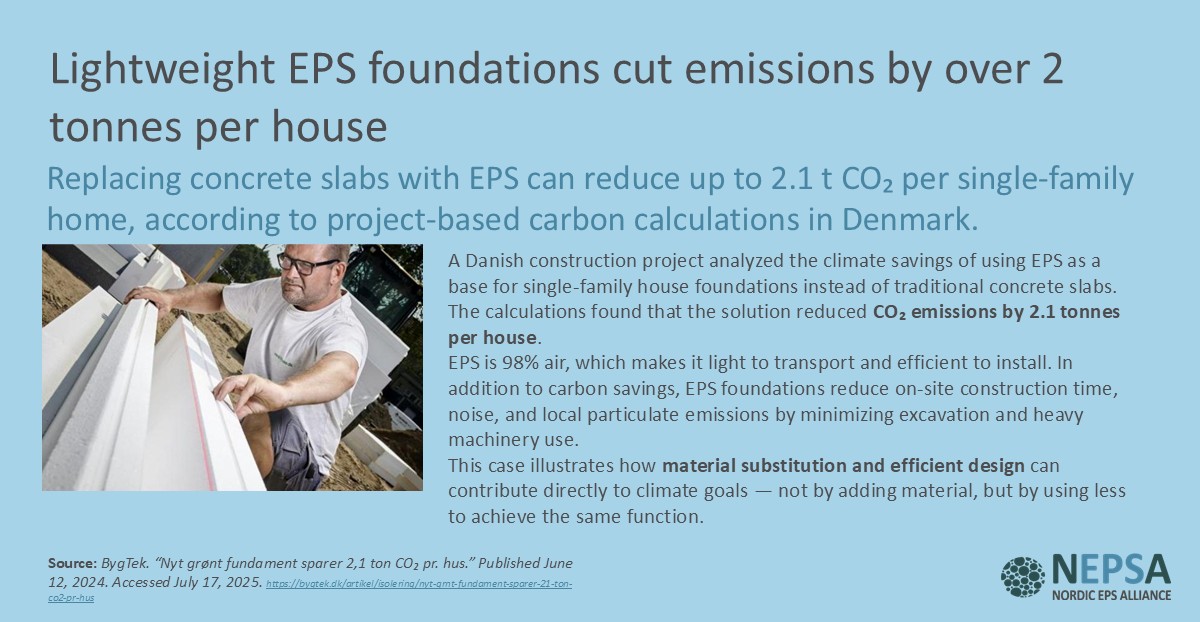
Expanded polystyrene (EPS) is not only used in buildings — it is also engineered for heavy-duty performance in infrastructure and civil engineering. When used as geofoam, EPS provides an exceptionally lightweight and reliable alternative to traditional fill materials, helping solve long-standing challenges in road construction, rail systems, foundations, and unstable ground.
With a structural weight that is only a fraction of soil or gravel, EPS significantly reduces settlement pressure, load on retaining walls, and stress on underground installations. It delivers consistent compressive strength, resists water absorption, and offers thermal stability in freeze–thaw environments. These qualities are particularly important in Nordic terrains, where climate exposure, soil variability, and construction timelines demand material efficiency and resilience.
Built for ground-bearing reliability
EPS geofoam typically weighs 10–50 kg/m³ — less than 2% the weight of soil — yet can support compressive loads typically ranging up to 350 kPa in standard construction grades. This enables stable embankment construction, backfilling against retaining walls, and foundation systems in areas with poor soil bearing capacity or high water tables.
By replacing heavier materials, EPS reduces both vertical loads on subsoils and lateral pressure on adjacent structures. It protects pipelines, culverts, tunnels, and other buried infrastructure from excessive stress and shifting. In slope stabilization and road widening, it also prevents uneven settlement and supports faster project execution.
Because of its closed-cell structure, EPS maintains dimensional stability and load distribution even in in damp or saturated conditions. It can accommodate minor subsoil movement, dampen vibrations, and reduce pressure transfer from external loads — helping ensure that roads, railways, and support structures remain functional over time.


Frost protection in Nordic conditions
Subsurface frost protection is essential in Nordic roadbeds and rail installations. EPS acts as a thermal barrier in pavements, embankments, and runways — limiting frost penetration and the resulting soil upheaval. Unlike granular insulation layers, EPS does not degrade or compact under pressure, ensuring long-term thermal resistance and subgrade stability.
Its lightweight nature also simplifies phased construction, particularly in settings where weather windows are short or staging areas are limited. It integrates well into layered systems and can be combined with other geotechnical materials depending on load and drainage requirements.
On-site efficiency and minimal disruption
EPS geofoam is delivered in factory-cut blocks that are easy to shape and position. Installation requires no curing, no compaction, and no heavy equipment — reducing time on site and allowing continuous progress even during cold or wet conditions. For urban retrofits and infrastructure upgrades, this helps avoid disruption to nearby transport systems or communities.
In public works across the Nordic region, EPS has been used to accelerate construction timelines, improve slope stability, and protect structural assets from dynamic soil movement. In Norway, it is part of the recommended solutions for road and rail systems in national infrastructure guidance.
A material aligned with ground reality
From foundation stabilisation to frost control and infrastructure protection, EPS performs where traditional fill materials fall short. Its engineered lightness, predictable behaviour, and site-ready format allow for construction in geotechnical conditions that would otherwise require costly mitigation or reinforcement.
EPS geofoam delivers reliability under pressure — literally and structurally — and continues to prove its value in infrastructure designed to last.