
Why climate impact is only part of environmental performance
EPS is widely recognised for its energy efficiency and low operational emissions when used correctly. But climate is not the only environmental metric that matters. Water use, pollution, toxicity, land impact, and overall resource efficiency all shape how materials affect the environment.
In each of these categories, the actual performance of EPS depends not on assumptions about “plastic” as a class — but on what the material does, how it is used, and what it prevents.
Environmental impact is multidimensional
Life Cycle Assessment (LCA) includes more than just carbon. Well-established indicators also cover:
- Water consumption and scarcity
- Eutrophication and acidification
- Photochemical smog formation
- Particulate emissions
- Ozone depletion
- Land use and biodiversity loss
- Toxicity and eco-toxicity potential
In many of these categories, EPS compares favourably — particularly when measured per function. Its low weight, long service life, and system-relevant performance help reduce broader environmental burdens, not just carbon.
Performance, not appearance
Environmental impact is not determined by whether something looks sustainable — or even by whether it’s made from bio-based materials. A recycled component that fails early, or a heavier alternative that adds transport emissions, may have worse outcomes than a simple, low-input, non-biodegradable option that performs for decades.
EPS is often overlooked because it is lightweight, synthetic, and highly visible in certain waste streams. But its actual impact in use is often lower than materials that appear more “natural” or “sustainable” — especially when the full system is considered.
Replacing one environmental impact with another is not progress. The goal is to reduce total burden across all indicators — not to shift it from one metric to another.
Comparative scoring and single-score indicators
Some LCA methodologies — including those used in public procurement and product labelling — convert environmental indicators into a single impact score, aggregating categories into one overall measure of performance. These methods aim to reflect total environmental burden, not just climate cost.
EPS frequently performs well in these evaluations when judged per unit of function. In applications like building insulation or protective transport packaging, it achieves:
- High insulation or shock absorption per gram
- Low energy and water use in production
- Minimal chemical additives
- Stability in use, with low toxicity risk
While no material performs best in all categories, EPS consistently avoids trade-offs that would otherwise shift the burden elsewhere.
EPS performance in broader environmental categories
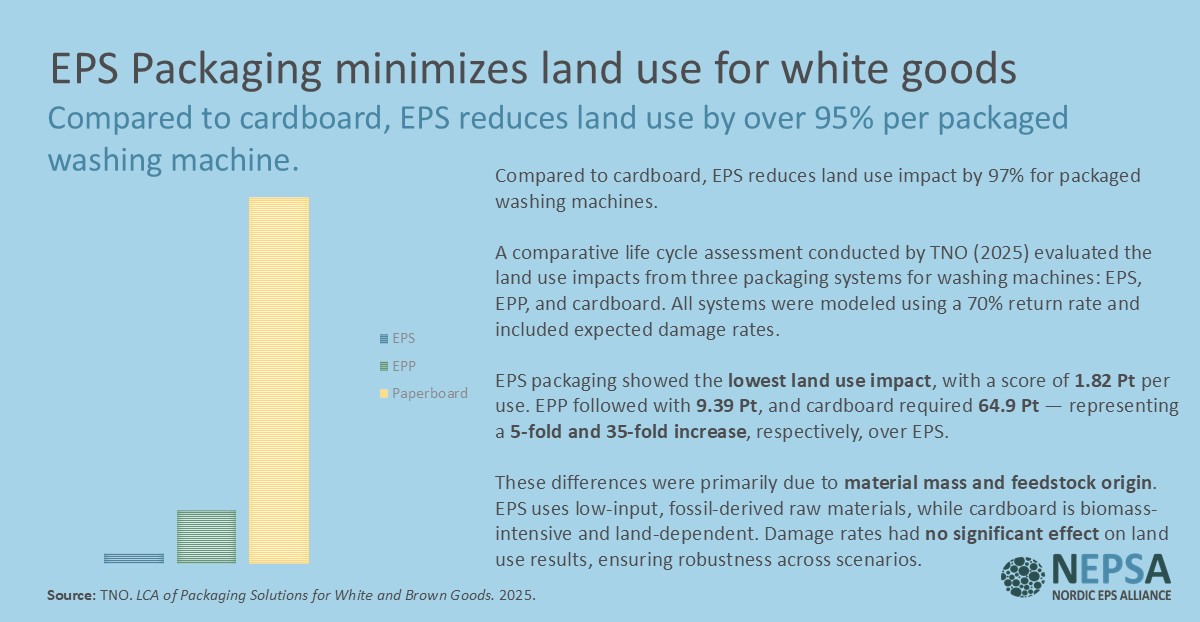

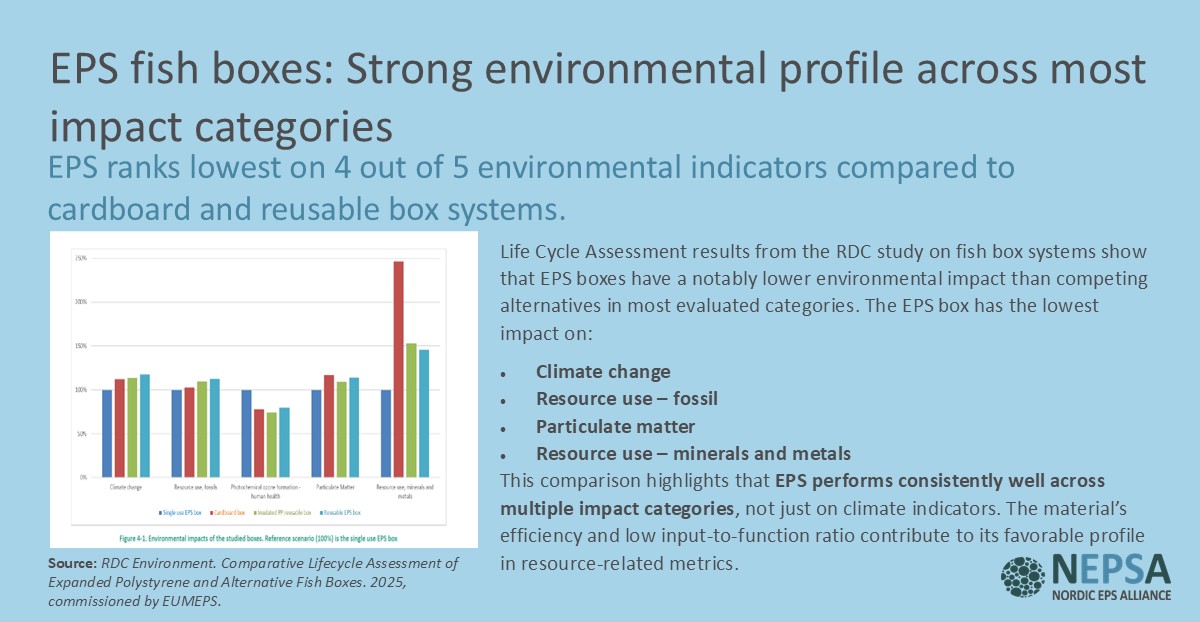
EPS is not a low-impact material by default. But in use cases where durability, lightness, and thermal or protective function matter, it consistently reduces environmental burden — not only in carbon, but in water, land, and air-related impacts.
True environmental performance must be measured across all relevant categories — and always relative to the outcome delivered. When judged this way, EPS is not a compromise. It is a practical solution with strong, evidence-backed performance across a wide range of indicators.