
Why life-cycle value matters more than material origin
Expanded Polystyrene (EPS) is fossil-derived — but that alone does not define its climate performance. When used in the right roles, EPS reduces more emissions than it generates. This is not an offset claim. It is a reflection of what EPS prevents: unnecessary heating demand, spoilage, breakage, and wasted energy.
Climate impact must be assessed over time and across use — not simply at the point of production. Like any technical material, EPS has a footprint. But its purpose is not decorative. It is chosen to deliver long-term thermal efficiency, product protection, and cold-chain reliability in regulated systems. In those settings, and when appropriately used the impact it avoids exceeds the impact it causes.
Use-phase performance, not production footprint
A kilogram of EPS is not the same as a kilogram of another material — because it serves a different purpose. Standard comparisons by weight or origin risk ignoring the very reason EPS is used: its ability to deliver high technical function with low mass and no energy input.
In Nordic buildings, for example, EPS insulation typically repays its production footprint in less than four years. After that, it reduces emissions for the lifetime of the building — often more than five decades — without requiring replacement or added maintenance. That contribution is not captured at the factory gate. It is earned over time, through performance.
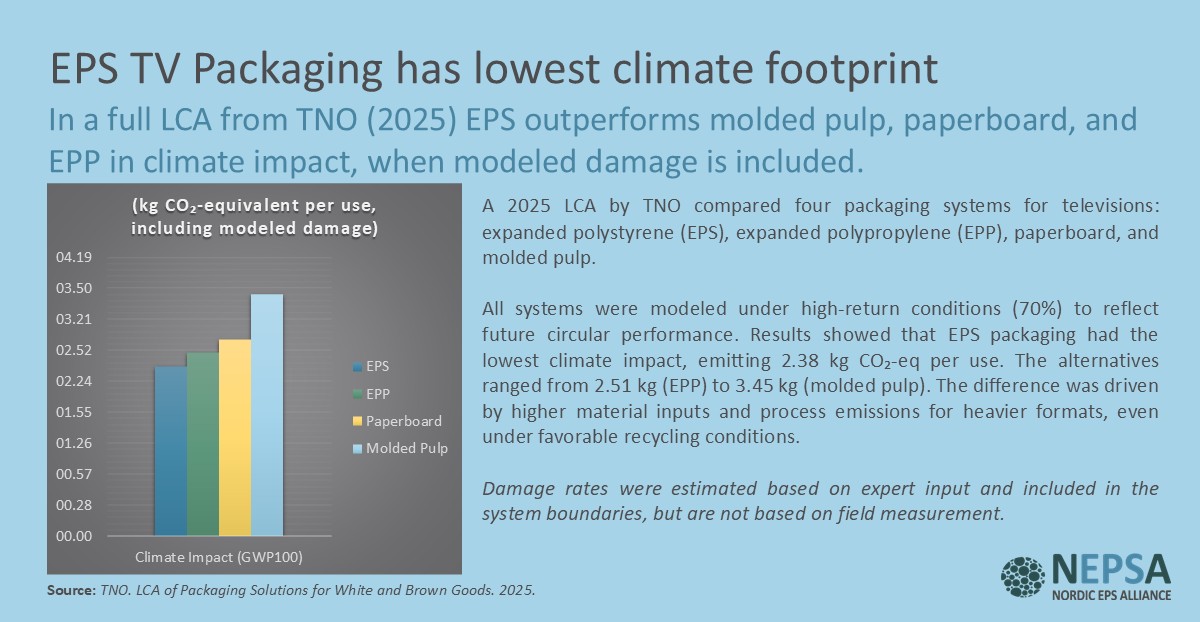
The same holds true in logistics and packaging. EPS keeps food and medicine within safe temperature ranges without powered refrigeration. It protects high-value goods in transit, reducing damage and avoiding the emissions tied to remanufacture, replacement, or return.
Evidence from system-based comparison
A global study by McKinsey & Company compared 14 material applications across their full life cycles. In 13 of those cases, plastic-based materials showed lower climate impact than available alternatives. The findings reflect real-world use, including emissions during production, use, and disposal.
The takeaway is that function defines footprint. A lighter, durable material that avoids waste or energy loss may have a greater climate benefit than one made from renewable inputs— if the latter fails to perform. And recycling may be the better solution if transport and cleaning impacts are higher – especially if recycling infrastructure is or can be put in place.
EPS Impact Cases


A material judged by what it prevents
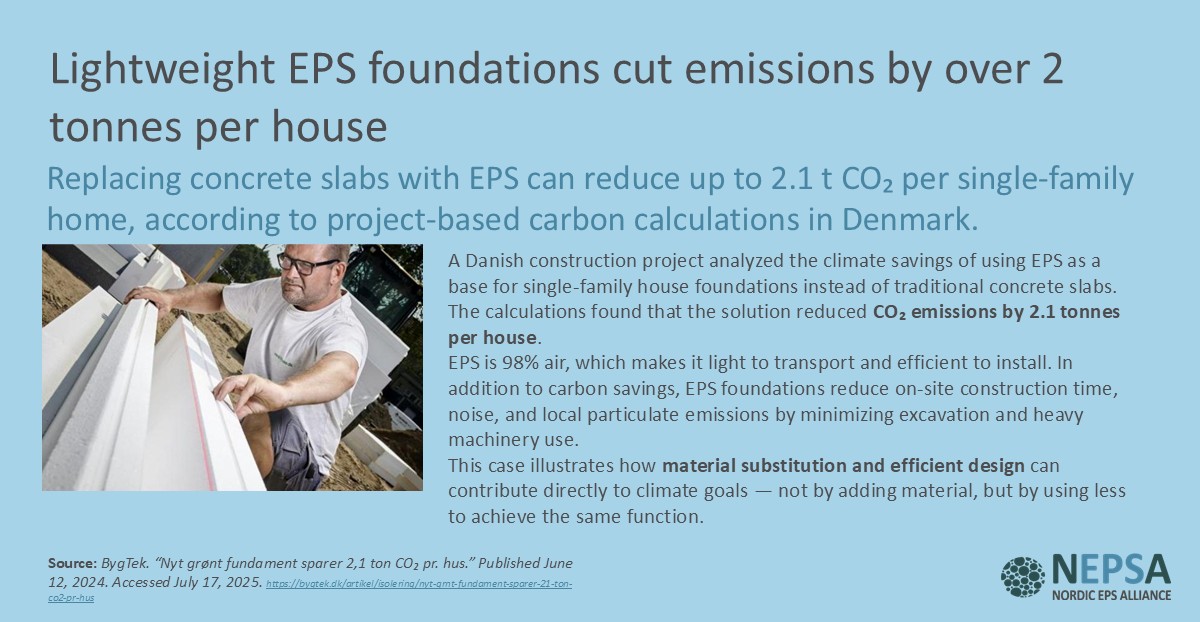
The environmental value of EPS is not abstract. It is visible in buildings that use less energy. In shipments that arrive undamaged. In vaccines that remain effective because temperature was held. These are not secondary outcomes. They are the reason EPS is used.
Judged on that basis — function delivered, emissions avoided — EPS stands among the most climate-efficient technical materials in its class. Not because it contains less, but because it enables more.