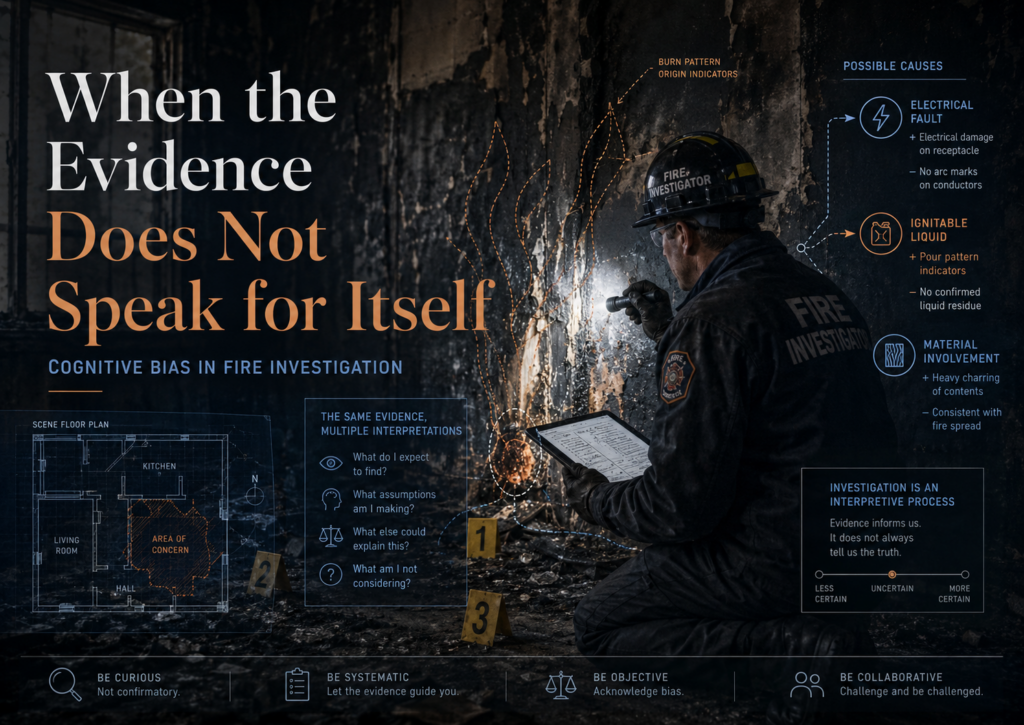
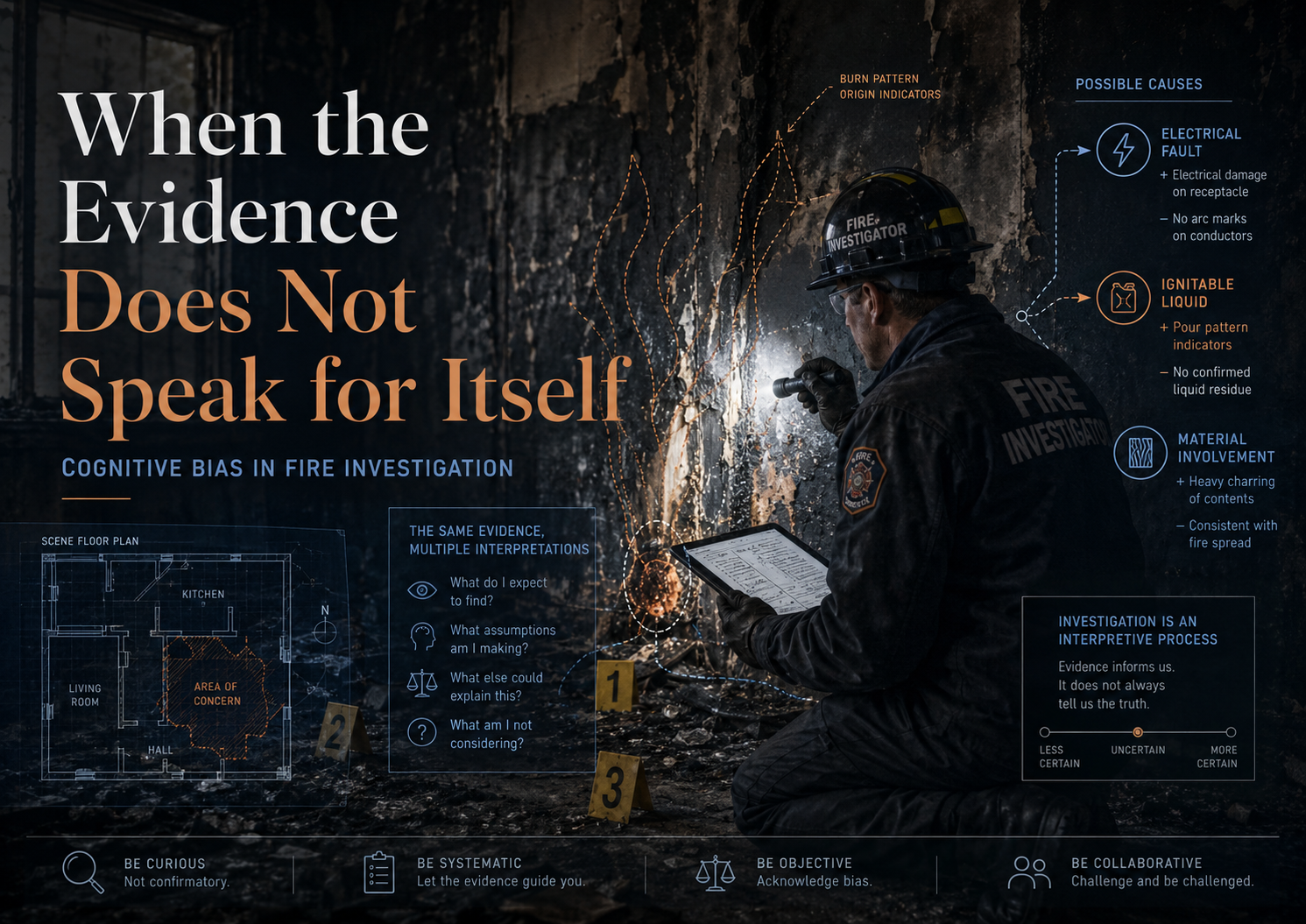
The second article in Chresten Heide-Anderson’s Beyond Fast and Easy Answers series examines how expectations and early hypotheses may shape the interpretation of fire evidence.
A fire leaves behind a scene, not an explanation.
Investigators may have witness accounts, recordings and information from the emergency response, but they cannot observe the complete event again. They must reconstruct it from evidence altered by fire, structural damage and suppression.
In his latest article, NEPSA director Chresten Heide-Anderson examines what this means for professional judgement in fire investigation.
The article draws on Paul Bieber’s research into expectation bias, confirmation bias and the interpretation of fire patterns. Bieber does not argue that investigators are careless or dishonest. His work instead shows why fire investigation requires safeguards that help experts distinguish observations from interpretations and keep alternative explanations open long enough to test them properly.
One of the central points is that an early hypothesis may begin to organise the investigation. Evidence that supports the hypothesis may receive greater attention, while contradictory findings face a higher threshold before they are allowed to change the conclusion.
The article applies this principle to the interpretation of material involvement in fires.
Finding combustible insulation in a damaged building may be relevant, but its presence does not establish how much it contributed to the fire. Investigators must still consider when the material became involved, how the surrounding construction affected its exposure and whether it materially changed the development or consequences of the fire.
As the article puts it:
Presence is not the same as causal significance.
This distinction may matter beyond the individual investigation. Fire reports and repeated incident narratives can influence insurance assessments, future risk guidance and the design of similar buildings.
The article also considers the 2021 Torre dei Moro fire in Milan. Early reports referred to polystyrene materials on the façade, while other contemporary accounts disputed that explanation and pointed towards separate aluminium composite elements. Later legal proceedings placed those panels at the centre of the prosecution’s case.
The Milan example does not prove that investigators were affected by cognitive bias. It illustrates how an early and easily understood explanation can enter public discussion before the complete construction and sequence of the fire have been established. Repetition may then make the explanation feel more credible without adding further evidence.
The wider lesson is not that professional judgement should be removed from fire investigation. That would be impossible. The aim should be to support judgement through procedures that limit irrelevant contextual information, encourage genuinely independent review and give competing explanations a fair opportunity to develop.
When the Evidence Does Not Speak for Itself is the second article in the Beyond Fast and Easy Answers fire-safety series. The first examined how cognitive bias may influence decisions before and during a fire. The next article will consider how framing and expectation may affect fire engineering, testing and design decisions before a fire occurs.
Read the full article: When the Evidence Does Not Speak for Itself