EPS should not be judged solely by what it is made from. All materials have impacts — and should therefore be assessed by what they prevent. This applies across buildings, packaging, and logistics.
In the case of EPS, it enables durable performance with minimal material input, helping reduce the environmental cost of energy use, product loss, and emissions over time.
Composed of up to 98% air, EPS combines technical function with low mass. Its contribution to climate efficiency is not symbolic — it is practical, measurable, and rooted in how little it takes to do so much.
Low material input, long-term benefit
EPS delivers thermal insulation, shock absorption, and structural integrity while requiring only a fraction of the raw material used in comparable solutions. With densities as low as 10–40 kg/m³, EPS delivers structural and thermal performance with minimal mass — often far lighter than traditional fill or insulation materials. Its production requires no binders and involves relatively low energy input compared to multi-material alternatives.
This means less energy used in production, less weight transported during distribution, and less material handled at end-of-life. From an environmental standpoint, these are not marginal savings. They are system-wide reductions in embedded impact.
Climate value in real-world systems
EPS’s material efficiency delivers environmental benefit only when used in systems that rely on it to prevent larger forms of loss. In insulation, this means reducing heating demand; in packaging, preventing spoilage or breakage; in infrastructure, minimising mass without adding load to soil or structure.
Especially when paired with efficient heating systems like heat pumps, EPS insulation pays back its production energy in just a few years — while remaining maintenance-free for the lifetime of the building, which may exceed 50 years.
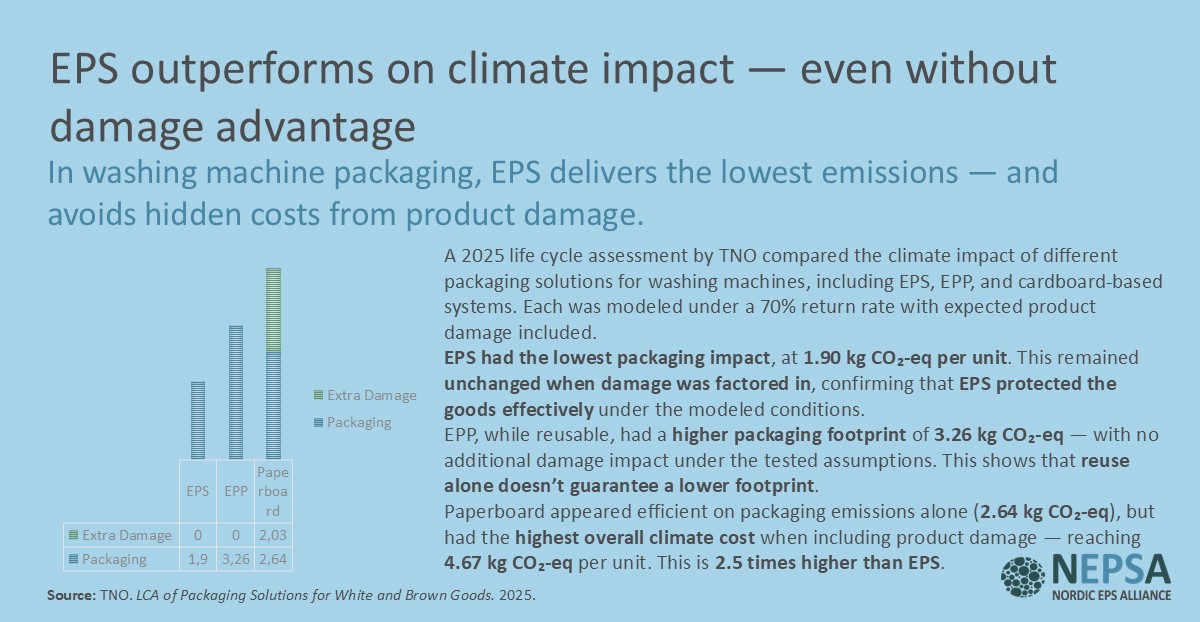
In cold chain logistics, EPS packaging prevents temperature excursions that would spoil food or vaccines. In product transport, it protects fragile items from damage. Even a modest increase in damage rates can outweigh the entire carbon footprint of the packaging — making EPS a small investment with disproportionately large climate benefits.
These avoided impacts are not secondary. They are the main reason EPS contributes to environmental targets in real systems.
Cost-Efficiency as a Factor in Environmental Outcomes
EPS is often selected not only for its material performance, but also for its cost-efficiency — especially in public systems where budgets must serve multiple environmental and social goals. Because EPS provides insulation, protection, and form-stability at low weight and low material input, it allows resources to be allocated where they deliver the most impact.
This does not make EPS inherently superior to other materials. Each application requires context-specific evaluation — comparing performance, cost, and environmental effect. In many cases, however, EPS offers a practical balance: enabling environmental outcomes at lower cost, which in turn supports broader access, fewer resource trade-offs, and greater scalability in systems that matter.
A material that earns its place
EPS is not without environmental cost. But the comparison is not to zero — it is to the alternatives. In many regulated systems, EPS outperforms heavier, multi-material, or high-maintenance options not because it is low-impact in origin, but because it enables low-impact outcomes in use.
In these roles, it offers strong environmental return per kilogram of input — extending the value of each gram through years of service, and reducing the need for added energy, added materials, or added cost across the system.
The right amount of the right material, placed in the right role, can deliver more climate value than any material claim alone.
EPS is not exempt from scrutiny. But when judged on what it prevents — not just what it contains — it stands among the most environmentally efficient technical materials in its class.