
| EXPLORE OUR THEME ON: EPS, FLAT ROOFS, PV PANELS & FIRE SAFETY | Use our drop down menu to quickly navigate the theme: |
The revised Energy Performance of Buildings Directive (EPBD) means that solar panels are rapidly finding their way onto European roofs, but the existing requirements and test methods were developed at a time when solar panels on roofs were not taken into account. The changed fire dynamics significantly increase the risk of horizontal and vertical fire spread, with potentially serious consequences, and it is currently unclear what safety level the authorities actually require.
Solar panels change the fire conditions of the roof
When solar panels are mounted above a flat roof, a partly enclosed cavity is created between the panels and the roof surface. The cavity can change the heat load, the flame path and the fire spread. A roof build-up that meets current requirements without solar panels therefore does not necessarily document how the finished roof build-up with solar panels behaves when exposed to a PV-related fire.
Fire safety should be assessed for the complete system:
- solar panels and electrical components
- panel layout and cavity geometry
- roof membrane and protective layers
- insulation and underlying structure
- mounting, fixings and point loads
- skylights, smoke ventilation and other roof penetrations
- detection, inspection, maintenance and fire-service access
- sectioning and firefighting options
What are the requirements for fire-safe roofs?
Clearer acceptance criteria are needed for meeting the functional requirements, including vertical fire exposure, horizontal fire spread, smoke production, fire development over time and access for effective firefighting.
Robust construction requires the building to work as one system in terms of fire, structure, water and moisture, climate, environment, operation and service life.
In brief
- Solar panels change fire dynamics on flat roofs significantly. How much this affects fire safety depends on the complete roof build-up.
- The risk of horizontal fire spread and extensive smoke production increases. This can make firefighting more difficult and affect people, animals, buildings and activities nearby.
- If the membrane is damaged, firefighting water and subsequent rain can increase the damage and extend business interruption.
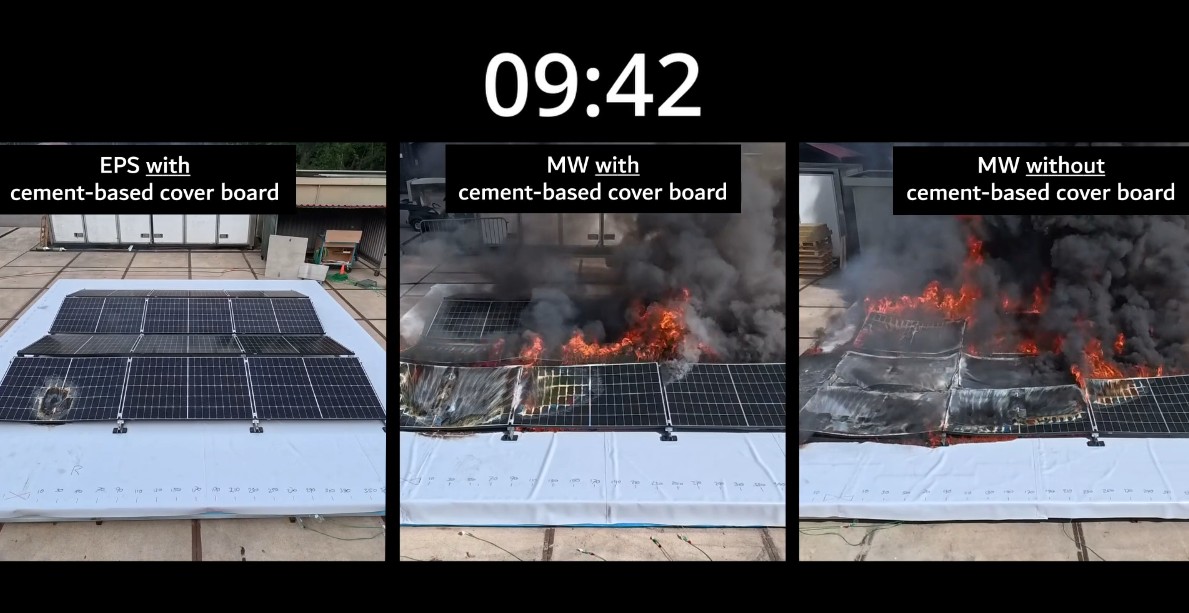
- The tests show that a protective layer with a documented effect in the specific build-up tested can reduce heat transfer and horizontal fire spread.
What is safe, and what is good enough?
Before a construction, a material or a protective layer can be described as sufficiently safe, the expected fire behaviour must be defined. Three questions are central:
- How far may fire and heat penetrate into the roof build-up?
- How far may fire spread horizontally beneath the solar panels?
- How long and how extensively may the fire develop before it creates an unacceptable risk to people, buildings, surroundings and the fire service’s operation?
Horizontal fire spread can damage a larger part of the roof membrane and roof build-up. Smoke, soot, firefighting water, subsequent rain and business interruption can extend the consequences beyond the area directly reached by flames. The absence of vertical burn-through is therefore not in itself a complete measure of the consequences of a fire.
Read more about the changed fire dynamics
12 mm cement-based cover board
The European EPS industry (EUMEPS), together with the German association IVH, has carried out a series of large-scale tests showing, among other things, that a 12 mm cement-based cover board can absorb heat and considerably reduce fire development in the build-ups tested.
Read more about the solution on the page on large-scale tests.
Read our recommendations to policymakers here:
| ID | Title | Content | Image | Date | Categories | Link |
|---|---|---|---|---|---|---|
| 3646 | IS A ROOFTOP PV INSTALLATION FIRE-SAFE? GOVERNMENTS NEED TO DEFINE THE TARGET. | A policy brief on safety requirements for PV panels on flat roofs | 2026/10/09 | Policy papers, position papers, etc., PV Panels, PV Policy | Download | |
| 3642 | EUROPE SHOULD DEFINE THE FIRE-SAFETY OUTCOME FOR ROOFTOP PV BEFORE CHOOSING THE TECHNICAL ROUTE | A position paper on required fire behaviour, EPBD implementation and fire safety requirements for PV … | 2026/10/09 | Policy papers, position papers, etc., PV Panels, PV Policy | Download |