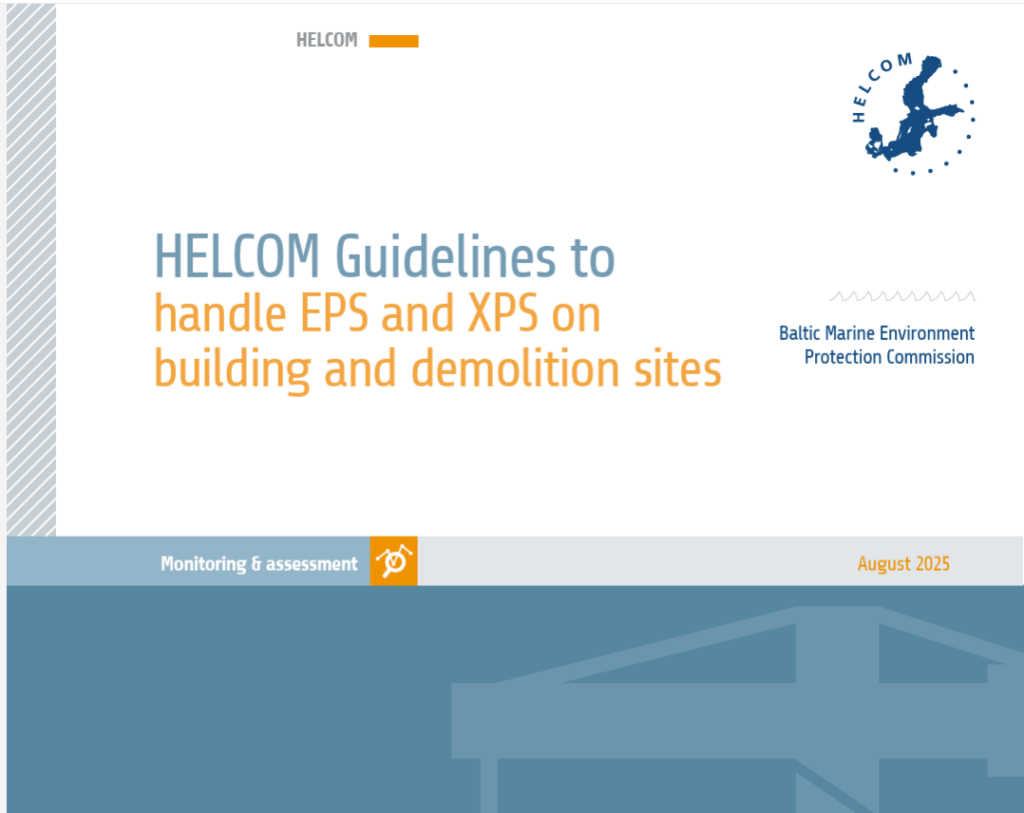

HELSINKI, 2025 — The Helsinki Commission (HELCOM) has published new guidelines to support the sustainable handling of expanded (EPS) and extruded polystyrene (XPS) on construction and demolition sites. The guidelines aim to minimise material losses, reduce environmental emissions, and increase circularity across the Baltic Sea region.
Developed in cooperation with the European EPS industry, the document offers a practical, end-to-end toolbox covering planning, on-site product use, and waste management. It outlines how EPS/XPS waste can be effectively collected, sorted, and recycled, while preventing losses during storage, transport, and processing.
“EPS and XPS are among Europe’s most widely used insulation materials due to their light weight, durability, moisture resistance and high energy-saving performance. Over their lifetime, these materials save many times more energy and CO₂ than are required for their production. With well-designed collection and recycling systems, they contribute meaningfully to Europe’s climate and resource-efficiency objectives,” says Chresten Heide-Anderson, Director of NEPSA and co-author of the guidelines.
Key recommendations from the HELCOM Guidelines include:
- Sustainable planning: choosing appropriate products and suppliers offering take-back and resource-efficient systems.
- Safe practices on site: secure storage, dust-free cutting methods, and immediate clean-up to prevent material loss.
- Recycling over disposal: clean EPS waste can be recycled mechanically, chemically, or via emerging innovative technologies.
- Special handling of legacy materials: insulation containing HBCD must be separately managed and sent to thermal recovery or recycled via approved processes such as PS Loop.
EPS and XPS are not major contributors to Baltic Sea microplastic pollution
The Guidelines emphasise that EPS and XPS are not among the primary drivers of microplastic pollution in the Baltic Sea. Scientific evidence referenced by HELCOM shows that tyre abrasion, synthetic textiles, and wastewater discharges dominate the microplastic load. EPS and XPS used in buildings are installed in closed systems where emissions can be avoided when proper handling and recycling procedures are followed—precisely the practices supported in the new Guidelines.
The document concludes: “Generally speaking, EPS is a valuable and sustainable material for the vast majority of its applications. When EPS waste is effectively collected and sorted it is easy to integrate in the circular economy.”
“We fully support this conclusion. Our role is to ensure that stakeholders know how to handle EPS correctly and to promote the continuous increase of EPS material being returned to the circular economy,” adds Chresten Heide-Anderson.
The guidelines are available to stakeholders across construction, waste management, and policymaking, and support the EU’s broader ambitions for circularity and pollution reduction.
Download the full HELCOM Guidelines here:
https://helcom.fi/wp-content/uploads/2025/08/HELCOM-Guidelines-to-handle-EPS-and-XPS-on-building-and-demolition-sites-2025.pdf
About HELCOM
The Helsinki Commission (HELCOM) is an intergovernmental organisation dedicated to protecting the Baltic Sea marine environment. Established in 1974, HELCOM brings together the Baltic Sea coastal states and the European Union to work on reducing pollution, conserving biodiversity, and promoting the sustainable use of marine resources. Its guidelines and recommendations provide practical tools to improve environmental performance and support regional sustainability goals.