
NEPSA publishes its position on the Global Plastics Treaty
The Nordic EPS Alliance (NEPSA) has released its position on the ongoing negotiations for a Global Plastics Treaty. The objective is clear: support measures that genuinely reduce plastic pollution while ensuring that policies do not unintentionally increase climate or resource impacts across the wider material system. The position paper outlines how evidence-based, material-neutral approaches can deliver stronger outcomes for the environment, the economy and society.
Plastic pollution requires decisive action, but effective action depends on sound design. Many of the proposals discussed in the negotiations touch directly on essential packaging and insulation applications. These products serve critical societal needs – from food safety to cold-chain logistics and energy-efficient buildings. For these functions, decisions must be grounded in science and in the performance of alternatives across their full life cycle.
A life-cycle approach is essential
NEPSA supports aligning plastic production with sustainable levels. However, sustainable levels cannot be defined in isolation from the materials that would replace plastics. Without comparative life-cycle assessment, production caps risk shifting demand to heavier or more resource-intensive alternatives – increasing CO₂ emissions, resource use, and waste. Evidence from UNEP and HELCOM demonstrates the importance of evaluating materials holistically rather than focusing on plastics alone.
EPS performs well in circular systems
Expanded polystyrene (EPS) is fully recyclable when systems are in place, and several countries are already demonstrating recycling at scale . UNEP’s Plastic Pollution Science report recognises EPS transport packaging as recycled “in practice and at scale”, while HELCOM studies show that EPS contributes only a very small share of marine litter relative to its production volumes.
In Nordic countries, efficient collection systems achieve recycling levels that significantly exceed typical averages. Norway’s near-90% recycling rate for fish boxes exemplifies how targeted design, strong EPR schemes and stable end-markets can virtually eliminate leakage.
Avoiding perverse substitution
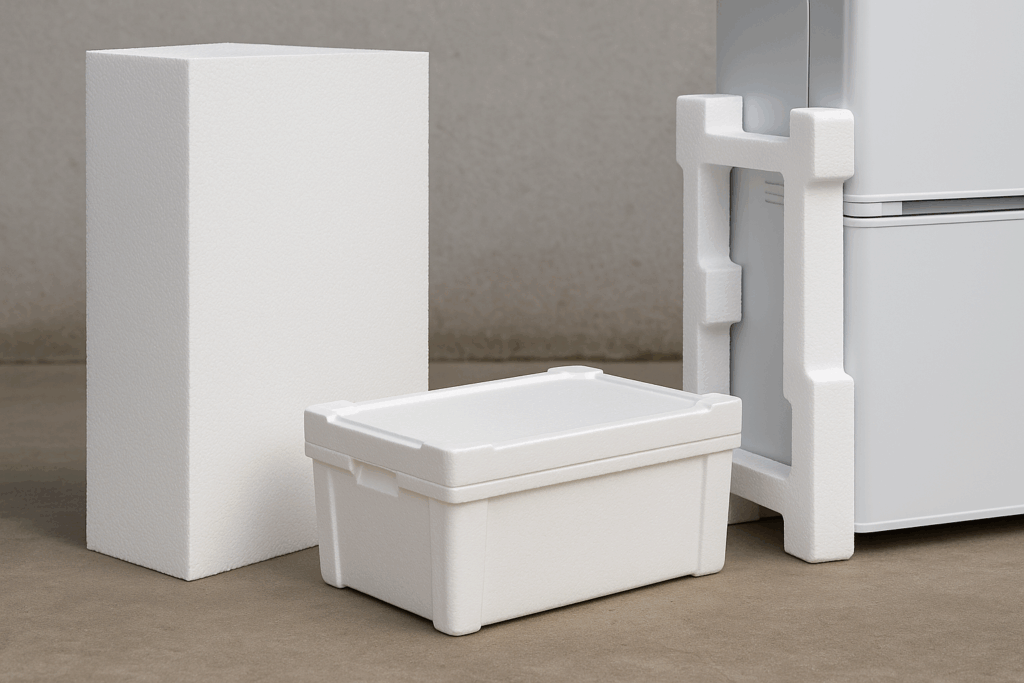
The treaty aims to identify “problematic” products, but proposals often lack clear definitions of recyclability, leakage risk or necessity. NEPSA supports robust criteria – provided they apply equally to all materials. EPS delivers high protection with minimal material use (98% air), which reduces transport emissions and prevents product loss. Substituting EPS without evidence of better overall performance can increase environmental burdens, including food waste, energy consumption and greenhouse gas emissions.
Strengthening circularity across all materials
NEPSA’s position highlights three system levers that have proven effective:
- Extended Producer Responsibility (EPR) across all materials, not only plastics, with revenues reinvested in appropriate collection and recycling systems.
- Recycled content requirements, which drive demand for high-quality secondary materials and create a business case for investment.
- Phase-down of landfilling, with priority given to recycling over disposal.
When these measures are aligned, EPS can remain in a circular loop rather than entering the environment.
Addressing chemicals of concern
Legacy flame retardants such as HBCD have been phased out since 2016. Modern EPS uses polymeric flame retardants that are neither toxic nor bioaccumulative, as noted in the HELCOM Guidelines (2025) . Regulation of chemicals must remain material-neutral: a hazardous substance should be restricted across all materials in which it appears, not only in plastics.
A science-driven pathway to global progress
NEPSA welcomes the ambition of the Global Plastics Treaty and supports its objective: to protect the environment and human health through a full life-cycle approach. Effective solutions require coherence between design, production, chemicals regulation, waste management and circularity measures.
Our position is straightforward:
Reduce pollution at source, strengthen circular systems across all materials, and ensure that interventions lead to real environmental gains, not unintended increases in climate or resource impacts.
Download the full position paper
The full NEPSA Position Paper on the Global Plastics Treaty is available here: