
In Brazil, expanded polystyrene (EPS) — widely known by the brand name Isopor — has long been misunderstood: often excluded from formal recycling schemes, it was seen as a lightweight nuisance, destined for landfill despite its recyclability.
But today, that perception is shifting. According to data published by O Globo and industry association Abiquim, Brazil achieved a post-consumer EPS recycling rate of 30.9% in 2020 — the second-highest among plastic materials, behind only PET. This reflects not just an industrial effort, but a maturing circular system built over more than a decade.
At the center of this shift is Termotécnica, a major EPS packaging producer based in Joinville (SC). For 14 years, the company has operated a nationwide reverse logistics program to recover and recycle EPS. The model engages producers, distributors, retailers, cooperatives, and final consumers to return clean EPS waste for processing. Over 44,000 tonnes have been recycled by Termotécnica alone.
The recovered material undergoes mechanical extrusion, transforming it from expanded EPS to compacted PS feedstock. This feedstock is then used to manufacture new items such as picture frames, skirting boards, shoe soles, and decking panels. In some cases, it re-enters the value chain as refrigerator components — notably through partnerships with Unigel and Electrolux.
The circularity pathway is reinforced by QR codes on packaging that direct consumers to Sou Reciclável, a digital platform promoting correct disposal behavior. Termotécnica now partners with over 300 cooperatives and 30 waste managers in Brazil, helping to operationalize the material flow from collection to reuse.
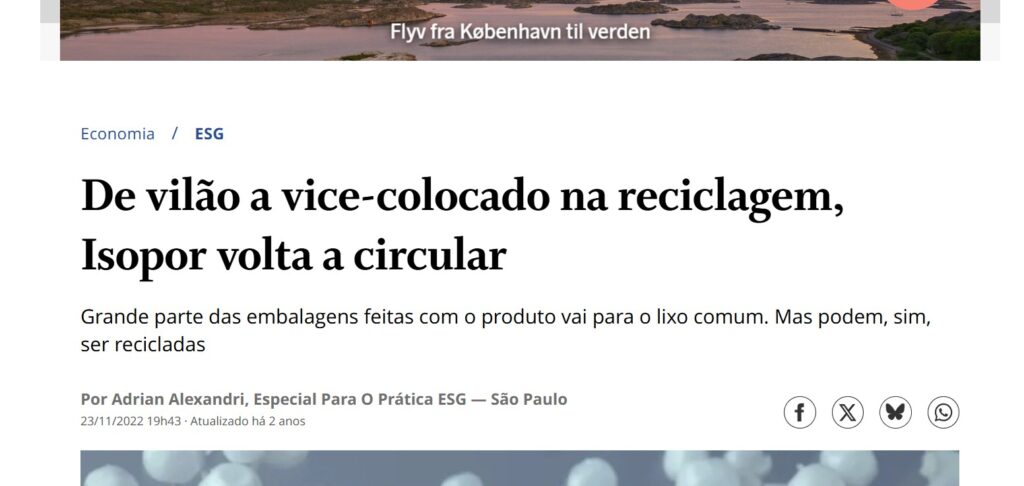
While the article acknowledges ongoing challenges — including transportation cost and public awareness — the system is functional, growing, and industry-integrated. It also shows resilience against substitution: molded pulp and cellulose alternatives are explored, but EPS retains a unique position due to its insulation capacity and mechanical strength.
Brazil’s experience shows that EPS can shed its outdated reputation. With structured reverse logistics, long-term partnerships, and circular system design, it is no longer a problem material — it is a working example of material reuse in action. 📎 Read the full article at O Globo