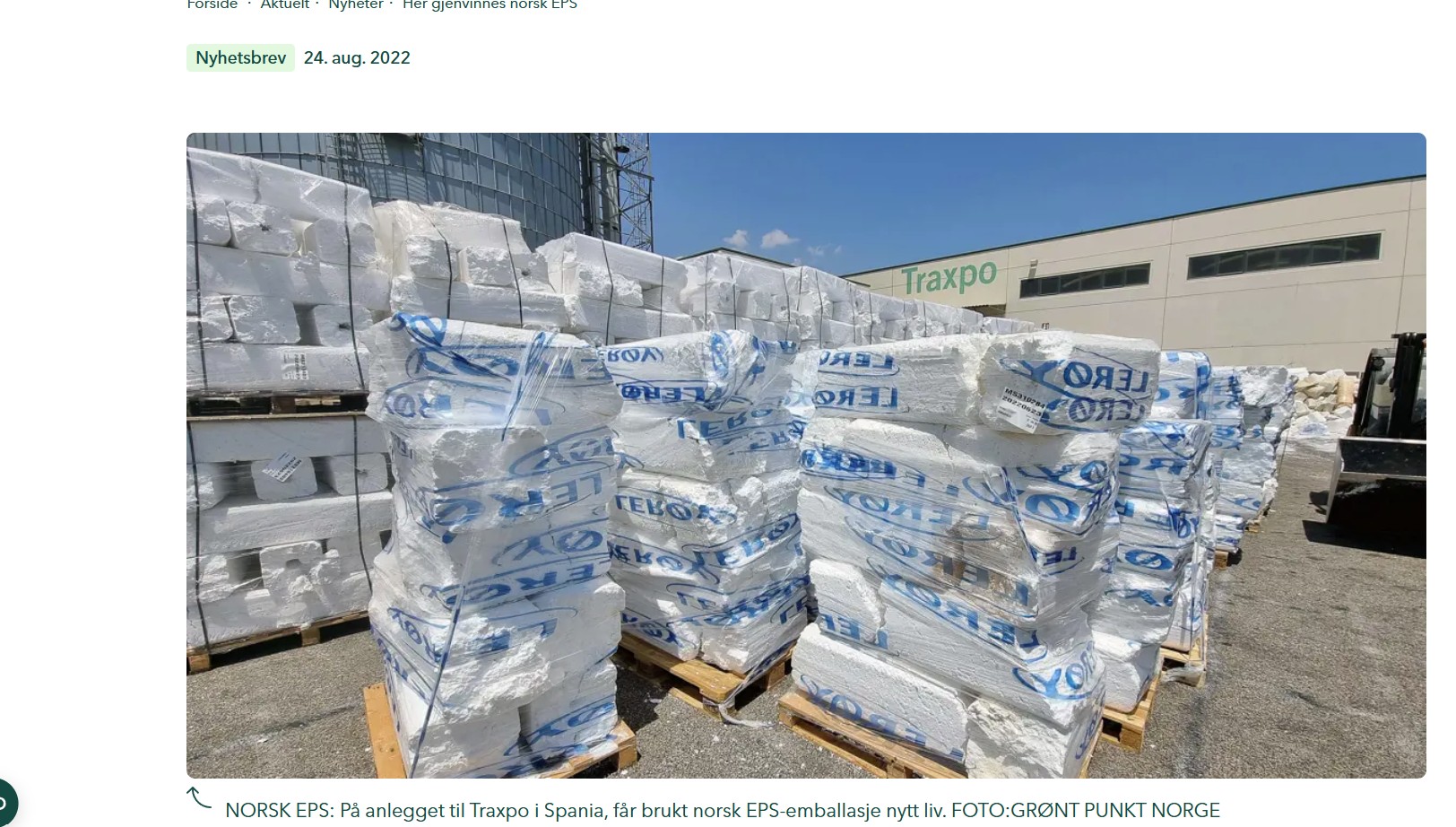
Efficient circularity for Norway’s expanded polystyrene (EPS) starts far from home. Through the coordinated efforts of Grønt Punkt Norge and Plastretur, EPS waste collected in Norway is now recycled into new insulation boards at Traxpo’s recycling facility near Barcelona.
In 2021, the Norwegian system captured 6 412 tonnes of EPS. Of that, 589 tonnes were sent directly to Traxpo in Spain. Material that arrived clean and well-sorted was processed into pellets through grinding and extrusion. Immediate reuse followed: Suprema Group, operating next door, turns the regranulate into XPS (extruded polystyrene) boards for construction (Grønt Punkt Norge).
How the system works
Grønt Punkt Norge oversees packaging collection via the Plastretur scheme, guaranteeing traceability from collection to final recycling. Norwegian collectors label and sort EPS, which is then baled and exported to certified recyclers. At Traxpo, the process includes shredding, drying, extrusion into high-quality regranulate and forwarding it to Suprema Group for on-site production of XPS boards (Grønt Punkt Norge).

Traxpo maintains two European facilities (Spain and Belgium), capable of processing EPS from households and businesses. Their location in Europe enables reduced transportation-related emissions and enhanced regulatory control compared to former reliance on Asian recyclers (Grønt Punkt Norge).
Fact Box
| Item | Value |
| Collection in Norway | 6 412 t EPS in 2021 |
| Sent to Traxpo (mid‑2022) | 589 t |
| Recycling rate | 87.4% (post‑processing) |
| European recycling share | 97.9% |
| Export destinations | Europe & Asia (2.1%) |
| Recycling facility | Traxpo, Tarragona (Spain) |
| Secondary use | Suprema Group (XPS plate production) |
Strategic relevance
This case highlights how advanced traceability and regional infrastructure can elevate EPS circularity. With nearly 90 % of collected EPS recycled—mainly within Europe—it sets a benchmark for transparent and efficient material recovery. Moreover, local closed‑loop production of XPS boards directly on-site reduces transport emissions and enhances resource value retention within supply chains.
Conclusion
The Norwegian EPS case demonstrates that high recycling rates and circular reuse pathways for lightweight packaging are not just feasible — they are already in practice. By coupling strict tracking, regional partnerships, and proximity-driven processing, Norway’s Plastretur and regional partners like Traxpo and Suprema Group advance the EPS industry toward a resilient, circular future.
Source: “Her gjenvinnes norsk EPS,” Grønt Punkt Norge, 24 August 2022 — Grønt Punkt Norge