Silkeborg Forsyning, the municipal waste utility in Silkeborg, Denmark, began a dedicated program in 2012 to separate expanded polystyrene (EPS, commonly known as “flamingo”) from general plastic. The effort reached a crucial milestone when the utility installed a compaction facility to enable efficient recycling of clean white EPS from households and local businesses.
Local separation with measurable outcomes
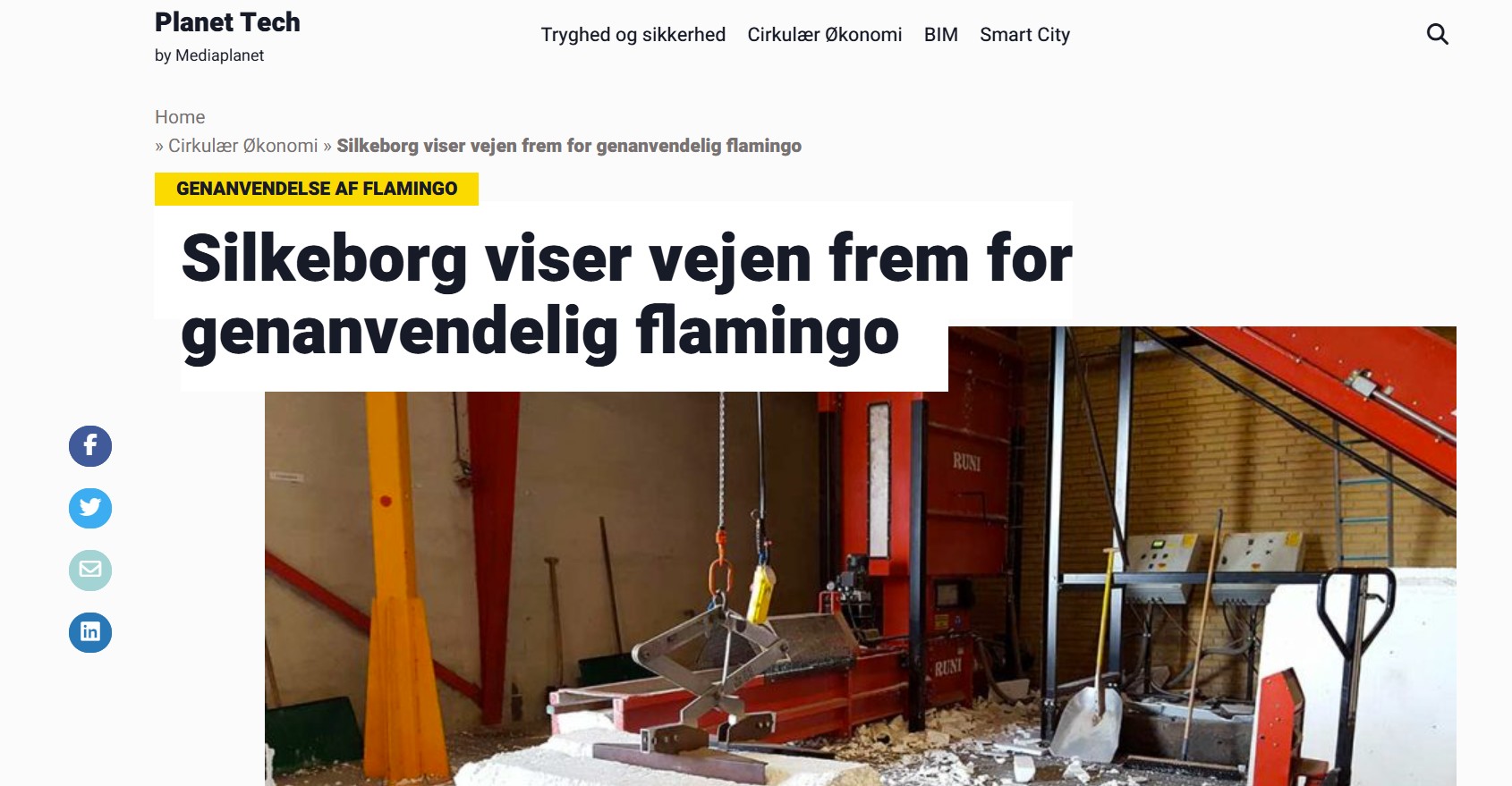
The facility, located at Silkeborg’s recycling sites, first shreds the EPS into smaller pieces before compacting it by up to 30:1. What used to occupy 30 m³ now takes up just 1 m³. This substantial volume reduction created immediate logistical efficiencies: instead of dispatching around 50 truckloads for incineration, Silkeborg now sends three compacted loads to recyclers annually — enabling real resale at market prices.
Economics of circular recycling
Erich Beck, an engineer at Silkeborg Forsyning, explains the financial upside:
“There is also an economy in it. … we now recycle it by reselling it, and it is actually paid at a fairly reasonable price. When we have enough to fill a load, we contact our sales channel.” (Planet Tech)
The facility annually processes approximately 30 tonnes of clean EPS, sourced from private households and local craftsmen. The dedicated system has extracted EPS from landfill or energy recovery streams and turned it into a marketable secondary resource.
Logistics, quality, and circular mindset
Silkeborg has long managed plastics in three separate streams: hard plastic, film plastic, and EPS. The densification step minimizes transport emissions and costs, but it also introduced a quality control challenge — contaminants like metal or mixed materials must be removed to avoid damaging compaction equipment or downstream recycling lines .
Beck notes:
“It weighs nothing and fills a lot… So environmentally and resource-wise, we have moved something from being burned to being recycled.” (Planet Tech)
Why it matters
- Volume reduction: Achieving up to 30:1 compaction drastically cuts the number of transport trips.
- Economic benefit: Sale of compacted EPS generates revenue rather than incurring disposal costs.
- Climate impact: Shifting EPS out of incineration into recycling notably reduces CO₂ emissions.
- Infrastructure alignment: The existing recycling site was retrofitted — no new building needed — demonstrating that municipal systems can flexibly integrate EPS recycling.
Silkeborg’s model stands as a proven example that municipal utilities can operationalize clean EPS recycling at scale, with clear economic, environmental, and logistical gains. It supports NEPSA’s mission to advance circular material systems by showing how local infrastructure adaptation can unlock new value streams while reducing waste.

FACT BOX
| Item | Value |
| Location | Silkeborg, Denmark |
| Launch | 2012 (compaction implemented later) |
| Annual throughput | ~30 tonnes of clean EPS |
| Volume reduction | Up to 30:1 via shredding and compaction |
| Transport impact | Reduced from ~50 to 3 truckloads/year |
| Quality control | Manual sorting to remove contaminants |
| Operator | Silkeborg Forsyning |
Source:
“Silkeborg viser vejen frem for genanvendelig flamingo,” Jesper Henning Pedersen, Planet Tech / Mediaplanet, April 2019
https://www.planet-tech.dk/…silkeborg-viser-vejen-frem-for-genanvendelig-flamingo/