
| EXPLORE OUR THEME ON: EPS, FLAT ROOFS, PV PANELS & FIRE SAFETY | Use our drop down menu to quickly navigate the theme: |
A flat roof that meets the requirements without solar panels does not necessarily behave the same way once solar panels are mounted on top. The modules create a partly enclosed cavity above the roof surface, and this changes how heat, flames and smoke move. Here we explain the mechanisms, and why a roof’s fire safety therefore has to be assessed as one system.
In brief
- Solar modules form a cavity between module and roof surface. The cavity can trap heat and smoke and send flames and radiant heat back towards the roof surface.
- This can lead to self-sustained flame spread beneath the modules, even on roof coverings that meet the current classification requirements.
- The gap between module and roof, the tilt of the modules and the material directly beneath the roof membrane strongly influence the course of the fire.
- The PV system adds new ignition sources, especially in the electrical installation.
- The consequences reach beyond the burnt area: smoke, firefighting water, subsequent rain and business interruption.
Fire on a flat roof without solar panels
When a small fire starts on a flat roof without solar panels, it heats the roof membrane close to the fire by radiation. The membrane releases combustible pyrolysis gases, but the heat rises freely into the air. Flame spread beyond the fire itself is therefore usually limited.[1]
In Europe, roof coverings are classified under EN 13501-5 as BROOF(t1) to BROOF(t4) on the basis of the test methods in CEN/TS 1187.[2] The methods test the roof covering without solar panels above it.
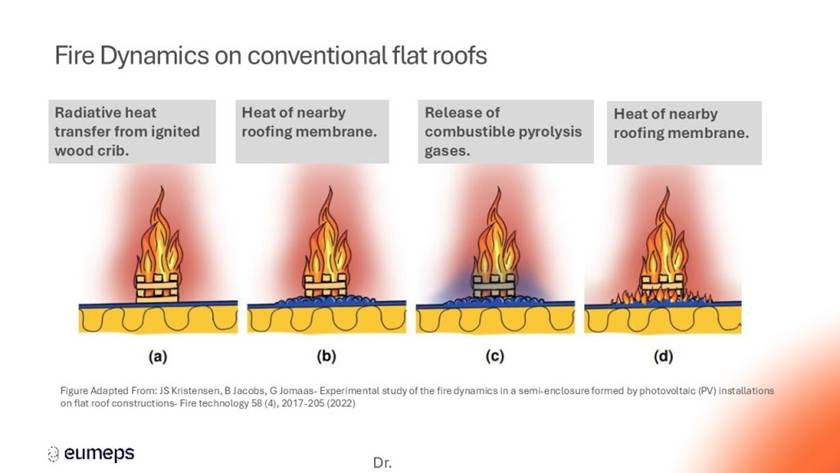
Figure 1. Course of a fire on a flat roof without solar panels: (a) radiant heat from the fire source, (b) heating of the membrane nearby, (c) release of combustible pyrolysis gases, (d) limited ignition of the membrane close to the fire source. Adapted from Kristensen, Jacobs and Jomaas (2022).
What the solar panels change
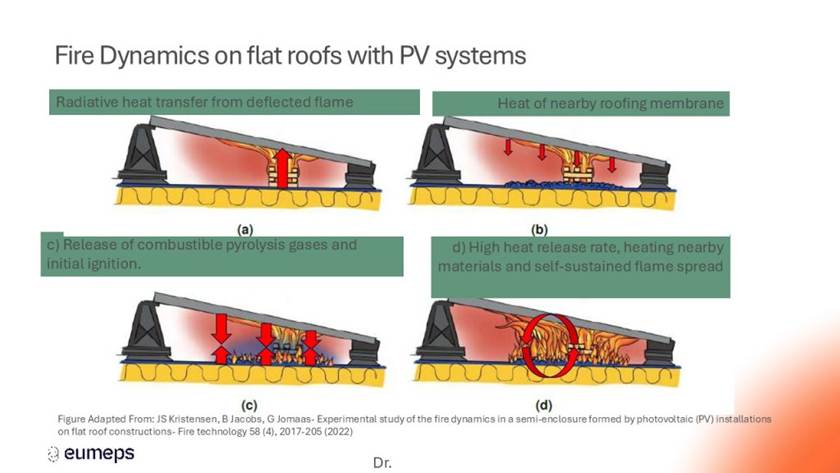
Figure 2. Course of a fire with a solar module above the roof surface: (a) the flame is deflected by the module and heat radiates down towards the roof, (b) the membrane is heated over a larger area, (c) pyrolysis gases are released and ignite, (d) high heat release and self-sustained flame spread beneath the module. The roof build-up is the same as in Figure 1. Adapted from Kristensen, Jacobs and Jomaas (2022).
1. The flame is deflected back towards the roof
Without a module, the flame rises vertically. With a module above, the flame and the hot fire gases are deflected in under the module. The module heats up and radiates heat back towards the roof surface (re-radiation). The heat exposure of the roof surface therefore rises significantly.[3] A review for the UK Building Safety Regulator reports measured heat fluxes of up to 50 kW/m² beneath solar modules, compared with 12.5 kW/m² in standardised test methods for roofs.[4]
2. Hot smoke is trapped beneath the module
In experiments at the University of Edinburgh, the module’s aluminium frame blocked the rising fire gases, so that a layer of hot smoke formed beneath the module. The smoke layer preheated the membrane ahead of the flame front, and the flames spread further.[5]
3. From local fire to self-sustained spread
Flame spread is in practice a series of ignitions: when the membrane ahead of the flame front reaches its ignition temperature, it releases enough combustible gases to ignite. Beneath a module, the extra heat can keep this process going even after the original fire source is gone.
The same experiments showed that a roof covering meeting the BROOF(t4) requirements did not prevent flame spread beneath the modules. On that basis, the researchers recommended a new test method that takes re-radiation into account.[5]
4. The gap to the roof is decisive
In the experiments, the result was binary. With 12 cm between a horizontal module and the roof surface, the fire did not spread. Below about 11 cm (10 cm with a steel plate instead of a module), self-sustained flame spread occurred. When the modules were tilted 10 to 15 degrees, the critical gap increased to more than 12 cm, and the flames spread about 25 percent faster.[5]
The researchers stress that the measured gaps are not universal and cannot be transferred directly to practice. The mechanism is the important point: the geometry beneath the module controls how much heat is fed back to the roof.
5. The layer beneath the membrane is of decisive importance
With a thin roof membrane, such as PVC, the properties of the layer directly beneath the membrane determine whether the membrane ahead of the flame front reaches its ignition temperature. A dense, cement-based layer acts as a heat sink: it absorbs energy from the preheating zone, the membrane does not ignite, and the flames go out because too little combustible gas is produced. With thicker bitumen roofing, the underlying layer matters less, because the temperature drop occurs through the bitumen itself.[6]
In tests with an 8 mm cement-bonded board, the board gave the same result whether EPS or mineral wool lay beneath it. DBI concluded that the insulation beneath the board had no influence on flame spread in those tests.[7] This is a central point: it is the build-up as a whole, and especially the top layer beneath the membrane, that determines the course of the fire, not the insulation’s fire class alone.
6. The fire follows the module array
In large-scale tests, the fire has typically spread beneath the module array, but not to any significant extent across the open roof surface. Brief ignition outside the modules has been seen when the wind deflected the flames outwards.[6][8] The placement of the modules, division into sections and spacing on the roof therefore matter for how large an area a fire can involve.
New ignition sources
A PV system adds new possible ignition sources to the roof: arcs in the DC circuit, faults in connectors and junction boxes, faults in inverters and isolators, and other electrical faults.[4][9] An analysis of fires on roofs with solar panels estimates about 28.9 fires per GW of installed capacity per year. In almost half of the fires analysed, the original ignition source was unknown or unrelated to the PV system.[9]
This underlines that the roof must be able to handle a fire regardless of what started it. Electrical safety reduces the likelihood of ignition. The fire properties of the roof build-up limit the consequences if a fire nevertheless occurs. Both are needed.
Consequences beyond the burnt area
The absence of burn-through is not in itself a full measure of the consequences of a fire.[10]
- Smoke can reach and contaminate neighbouring buildings without direct flame contact.
- Modules, mounting systems and access conditions can make firefighting on the roof more difficult. The modules produce electricity as long as they are lit, and the fire service must keep a safety distance when extinguishing with water.[11][12] If firefighting has to take place from ladders rather than from the roof, extinguishing can become less precise and water damage greater.[13]
- If the roof membrane has burnt away, rain and firefighting water can enter the building, and water from the rest of the roof can run towards the hole. 10 mm of rain on 100 m² of roof is 1,000 litres. How large the water damage becomes depends on how the building is used.[14]
- Depending on how the building is used, a roof fire can lead to business interruption, for example in pharmaceutical production with requirements for clean and dry conditions. The greater the damage, the longer the interruption can be.[13]
What does this mean for the assessment of the roof?
Existing roof classifications remain relevant within their scope. But they were not developed to describe how a finished roof build-up with solar panels should behave in a PV-related fire.[4][15]
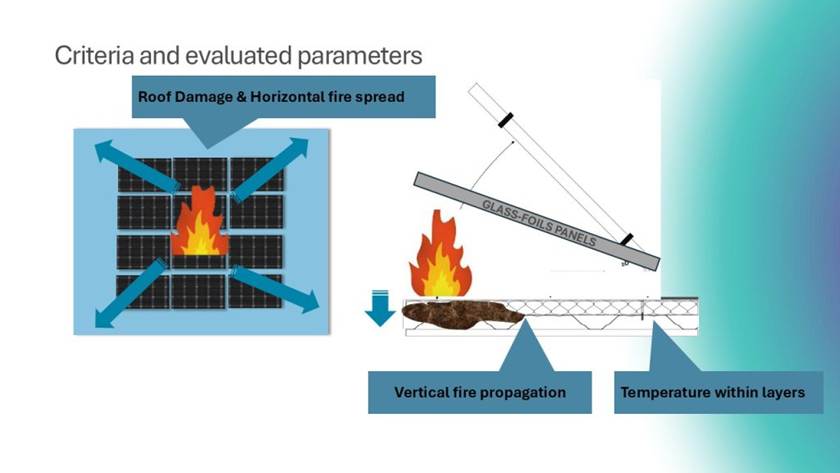
Figure 3. The three dimensions to be assessed: horizontal fire spread and roof damage, vertical fire propagation into the roof build-up, and the temperature between layers. (From Emanuela Gallo, EUMEPS)
The required fire behaviour must therefore be defined before technical solutions are chosen. Three questions are central:
- How far may fire and heat penetrate into the roof build-up?
- How far may the fire spread horizontally beneath the modules?
- How long and how intensely may the fire develop, including smoke production, before it creates unacceptable risk to people, building, surroundings and firefighting?
Once the criteria are defined, every roof build-up can be assessed against the same requirements, regardless of material.
Read more in NEPSA’s position paper.
What do the tests show?
In a European test series commissioned by EUMEPS and IVH, carried out by Kiwa BDA and analysed by DBI, 7 × 7 m roof build-ups with solar panels were tested with a gas burner beneath the edge of the module array.[6][7]
- With a 12 mm cement-bonded board between PVC membrane and EPS insulation, no self-sustained fire developed in three of four tests. In the fourth test, the fire spread beneath all modules, which DBI linked to stronger wind. In all four tests, the EPS insulation was affected only locally beneath the burner.
- With bitumen roofing, 12 mm board and EPS, the fire spread beneath all modules, but the EPS was affected only locally beneath the burner.
- With the PVC membrane laid directly on mineral wool, the fire spread self-sustainingly beneath the module array. The test was stopped after 11 minutes for environmental and safety reasons.
- With thinner cement-based boards (8 mm and 6 mm), the fire did not spread in two large-scale tests, but the EPS retracted further beneath the burner, up to 10 cm in three of four large- and medium-scale tests.
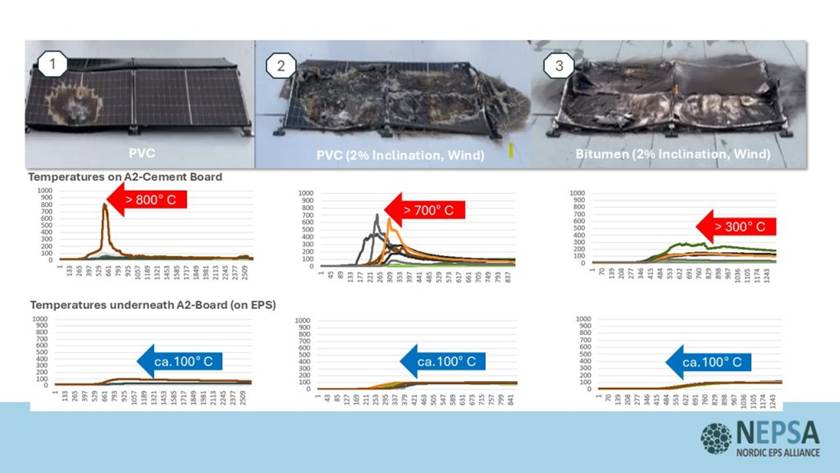
Figure 4. Three tests with 12 mm cement-bonded board on EPS: tests 1 and 2 with PVC membrane, test 3 with bitumen roofing. Top: membrane damage. Middle: temperature on the top of the board, above 800, 700 and 300 °C. Bottom: temperature beneath the board, on the EPS, about 100 °C in all three. In tests 2 and 3 the fire spread beneath the modules. Data: Kiwa BDA for EUMEPS and IVH.
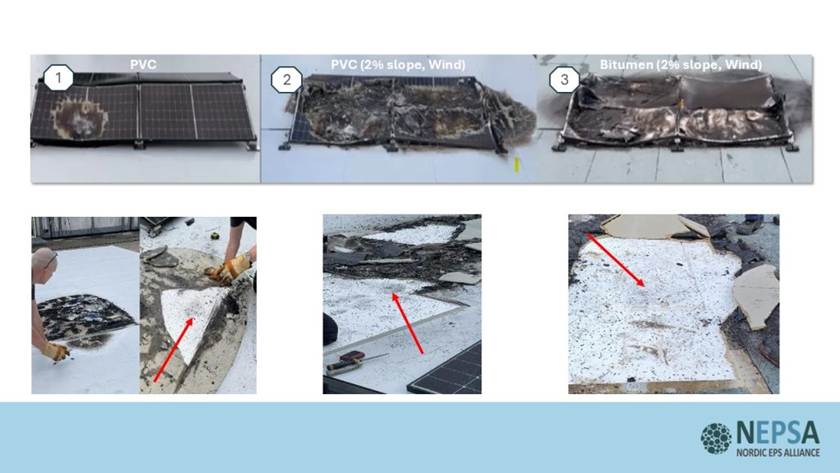
Figure 5. The EPS beneath the board after the tests in Figure 4. The arrows show where the EPS has retracted locally beneath the burner. The rest of the insulation is unaffected.
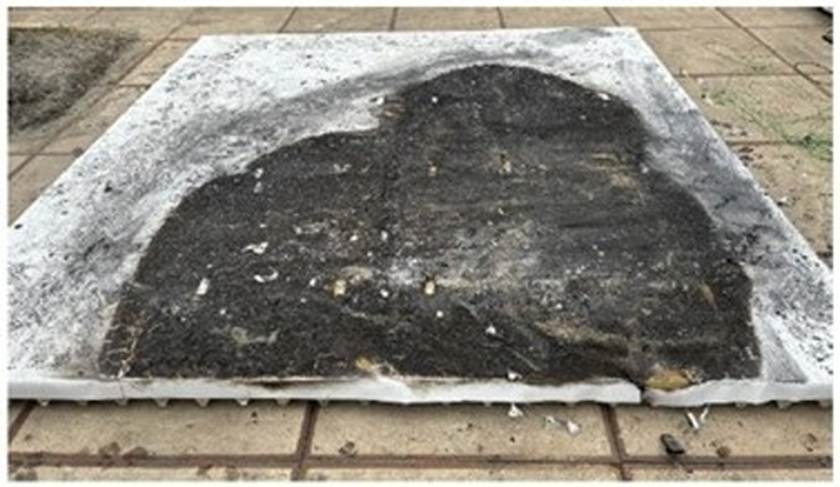
Figure 6. PVC membrane laid directly on mineral wool without protective board: damage to the roof covering after the test.
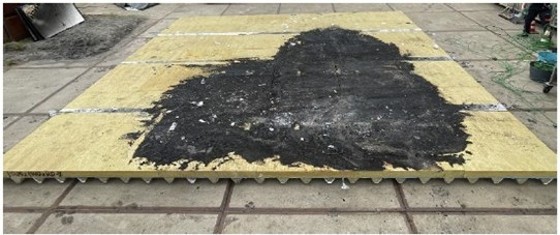
Figure 7. The same test: heat damage into the mineral wool after the membrane was removed.
The mineral wool test had no protective board and is therefore not a like-for-like comparison of insulation materials. In medium-scale tests with an 8 mm cement-bonded board, the fire went out both when the board lay on EPS and when it lay on mineral wool.[7] This supports the point that the layer directly beneath the membrane is decisive.
The tests are research and development tests. They were not carried out to a standardised method, do not represent an approved system and are not fire-classified. They show that a protective layer with a documented effect can change the course of the fire in the build-ups tested. Whether that is good enough depends on acceptance criteria that have not yet been set. See more under Large-scale tests.
Sources
- Kristensen, J. S. (2022). Fire risk associated with photovoltaic installations on flat roof constructions: Experimental analysis of fire spread in semi-enclosures. PhD thesis, The University of Edinburgh. https://doi.org/10.7488/era/3170
- CEN (2016). EN 13501-5:2016, Fire classification of construction products and building elements, Part 5. Test methods: CEN/TS 1187:2012.
- Kristensen, J. S., Merci, B. and Jomaas, G. (2018). Fire-induced reradiation underneath photovoltaic arrays on flat roofs. Fire and Materials 42: 316-323. https://doi.org/10.1002/fam.2494
- OFR Consultants (2026). Thermal Exposure to Roofs from Fires Involving Photovoltaic Panels, rev. R02, prepared for the Building Safety Regulator. GOV.UK, updated 13 February 2026.
- Kristensen, J. S., Jacobs, B. and Jomaas, G. (2022). Experimental study of the fire dynamics in a semi-enclosure formed by photovoltaic (PV) installations on flat roof constructions. Fire Technology 58: 2017-2054. https://doi.org/10.1007/s10694-022-01228-z
- DBI (2026). Large-scale tests of flame spread on roof build-ups with PV systems: A white paper. Report SIEC21006-003, March 2026.
- DBI (2026). Large-scale tests of flame-spread on roof build-ups with PV systems: Phase III. SIEC21006, March 2026.
- Kristensen, J. S. and Jomaas, G. (2018). Experimental study of the fire behaviour on flat roof constructions with multiple photovoltaic (PV) panels. Fire Technology 54: 1807-1828. https://doi.org/10.1007/s10694-018-0772-5
- Ong, N. A. F. M. N. et al. (2022). Fault tree analysis of fires on rooftops with photovoltaic systems. Journal of Building Engineering 46: 103752. https://doi.org/10.1016/j.jobe.2021.103752
- NEPSA and the Danish EPS Association (2026). Europe should define the fire-safety outcome for rooftop PV before choosing the technical route. Position paper, October 2026.
- Danish Emergency Management Agency (Beredskabsstyrelsen) (2012). Vejledning om redningsberedskabets indsats i forbindelse med solcelleanlæg [Guidance on fire-service operations at PV installations]. December 2012.
- DBI (2024). Brandsikringsforanstaltninger for solcelleanlæg: Planlægning, installation og egenkontrol [Fire protection measures for PV installations]. DBI Guideline 39, 1st edition (consultation edition), August 2024.
- Swiss Re Institute (2024). Rooftop solar: Emerging risk control needs for properties. October 2024, pp. 6-7. https://www.swissre.com/dam/jcr:0864e3dd-59f8-40c0-9b12-9f6f801a11d4/sri-expertise-publication-rooftop-solar.pdf
- FM Global (2023). Schroen and Nafzger: presentation on PV panels, SFPE Benelux, 5 April 2023. https://sfpebenelux.eu/wp-content/uploads/8-FM-Global-Schroen-Nafzger-PV-Panel-Presentation-5-april-2023-.pdf
- ZAG/FRISSBE (2024). BAPV Fire Safety Guideline, version May 2024.