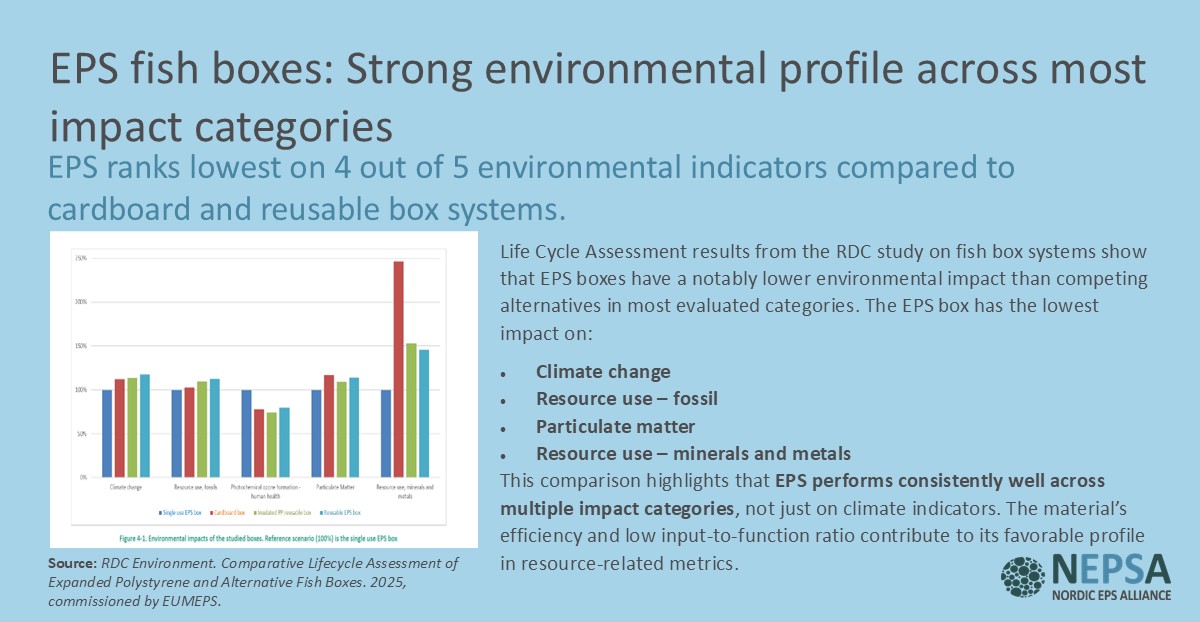
A new lifecycle assessment (LCA) by RDC Environment (2025) provides comprehensive evidence on the environmental performance of fish box systems used in chilled seafood transport. The study compares three formats — single-use expanded polystyrene (EPS), laminated cardboard, and reusable plastic boxes — using standardised ISO 14040/44 and PEF-compliant methods. The functional unit is defined as “1 kg of fish delivered under refrigerated conditions,” ensuring results reflect real distribution conditions rather than material production alone.
The analysis covers full system inputs and outputs, including transport, insulation requirements, spoilage risks, washing cycles for reusable systems, and end-of-life treatment. Results show that at short distances below 200 km, performance is broadly similar across formats. As distances increase, however, differences become clear. Between 200 and 500 km, EPS and insulated reusable plastic perform comparably, while cardboard becomes less favourable due to higher ice needs and spoilage sensitivity. Above 900 km, EPS consistently emerges as the lowest-impact option. At long distances typical of intra-European seafood trade (1250–2800 km), EPS maintains the lowest total environmental cost and climate impact per kilogram of fish delivered.
The findings also highlight that no single format dominates in every context, and that performance is highly dependent on transport distance and system conditions. Importantly, the study models steady-state operation and does not account for transition costs or infrastructure changes. This means that any real-world switch to lower-performing alternatives would entail additional financial and environmental burdens not reflected in the LCA.
Overall, the results provide new evidence that environmental performance in cold chain logistics must be assessed on a full-system basis. For long-distance seafood distribution, EPS offers a consistent balance of low climate impact, food safety, and operational reliability.
Source: RDC Environment. Lifecycle Assessment of Fish Boxes in Cold Chain Logistics. 2025.
NEPSA has developed a series off facts sheets about the study, which you can see below: