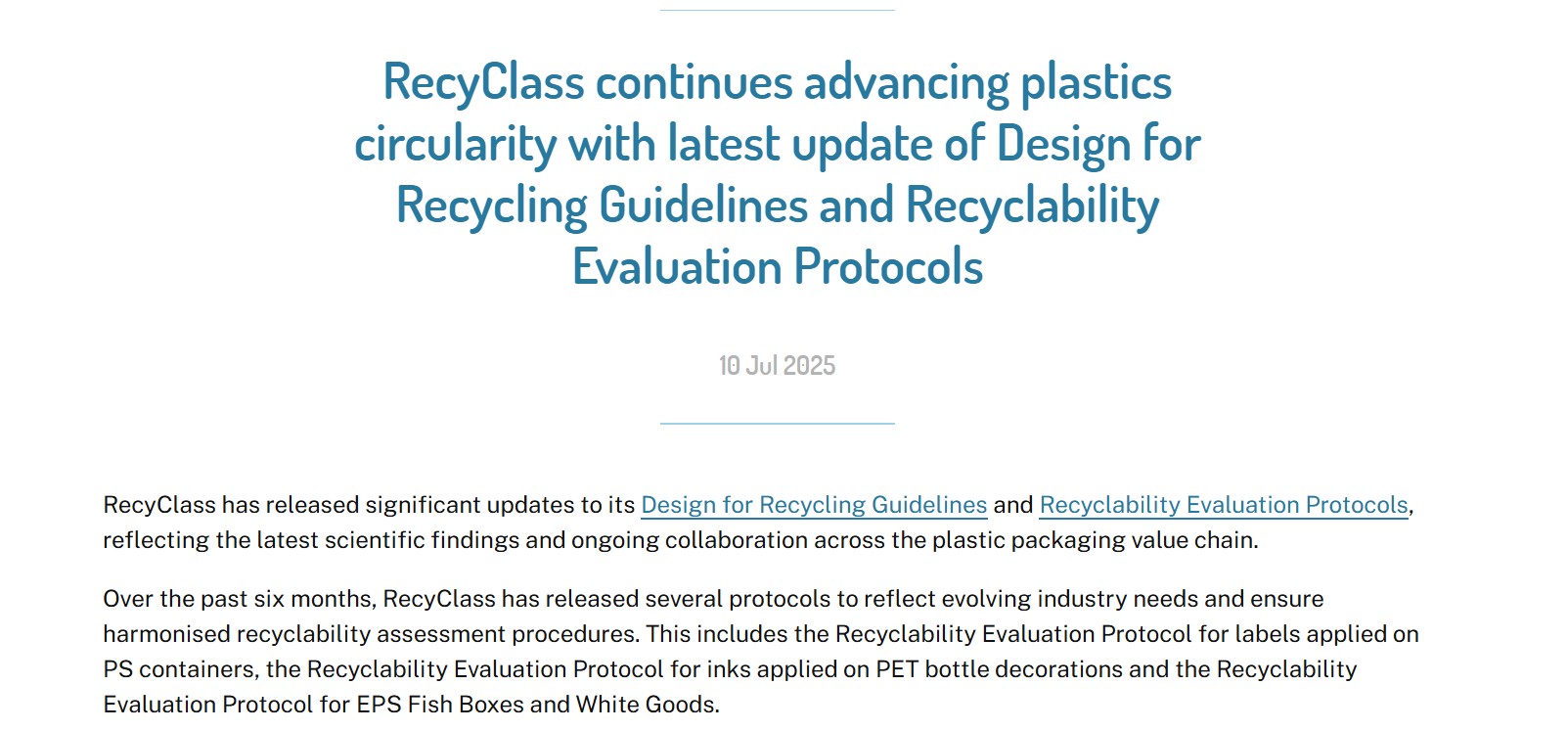
RecyClass, a cross-industry initiative based in Brussels, has released its latest update to the Design for Recycling Guidelines, this time explicitly including EPS packaging—such as fish boxes and white goods—in both the guidelines and the associated Recyclability Evaluation Protocols (RecyClass, petnology.com).
These refinements are based on 18 independent testing campaigns conducted in 2024. They examine how factors such as label types, adhesives, wall thicknesses, and material combinations impact EPS’s behaviour at sorting and recovery plants (RecyClass). The result is a clearer, more technical framework for designing recyclable EPS packaging—ensuring better grades under RecyClass’s traffic-light system (green = fully compatible, yellow = limited compatibility, red = avoid).
The updated guidance benefits industry stakeholders—packaging converters, brand owners, and recyclers—by:
- Providing evidence-based criteria for EPS packaging specifications.
- Supporting designers with clarity on features that enhance sorting and processing compatibility.
- Ensuring EPS can enter mainstream recycling streams more effectively.
With sections now covering EPS fish boxes and white goods explicitly, the guidelines help cement EPS’s place in RecyClass’ broader circularity agenda (RecyClass, RecyClass, RecyClass). This also strengthens alignment with evolving European regulation—such as the Packaging and Packaging Waste Regulation (PPWR), which elevates the importance of “design-for-recycling” across all polymer types (Wikipedia).
In practical terms, this means new-generation EPS packaging can now be assessed and certified under RecyClass protocols—providing clarity for both market-ready materials and innovation pipelines in recyclable polystyrene.