
The story: EPS collection becomes compact and circular
Denmark has rolled out a practical system to collect and process clean expanded polystyrene (EPS) packaging and insulation at designated recycling centres across the country. In mid‑2024, facilities began using high-capacity green EPS compactors (e.g., from GREENMAX), compressing foam to 1/50 its original volume on-site. The result: bulky EPS becomes easy to transport and manage, transforming it from a logistical liability into usable feedstock.
This change followed growing concern over transport inefficiency and landfill use. By adopting onsite compaction, Danish municipalities have made EPS visibly recyclable and part of the standard collection routine—reinforcing public trust and participation.
System logic: Compaction, shredding, and reuse
At participating recycling centres, clear bins for clean EPS direct material into screw‑press compactors. Once compressed, blocks are transported to industrial recycling centres where they are shredded, extruded, and pelletised. The resulting recycled polystyrene (rGPPS) pellets re‑enter the market as insulation boards, packaging, and durable plastic components.
The system avoids high transport emissions by reducing EPS volume by up to 50 times and ensures material quality by keeping streams clean and separated at the source.
Why this matters
This case shows how a simple, infrastructure-driven solution can shift EPS from a “waste problem” into a circular resource. Onsite compaction:
- Cuts transport and processing costs
- Enables clean, mono-material recycling
- Supports demand for high-quality rGPPS
By embedding EPS into the national recycling infrastructure, Denmark has taken a functional step toward improved circularity—no slogans, just system logic.
FACT BOX
| Item | Value |
| Launch | Mid-2024 (compactor rollout) |
| Location | National network of Danish recycling centres |
| Equipment | GREENMAX screw‑press compactors (50× volume reduction) |
| Collection type | Clean EPS packaging & insulation |
| Processing | Shredding → extrusion → pelletisation (rGPPS) |
| End uses | Insulation boards, packaging materials, injection‑moulded goods |
| Key benefit | Cuts transport costs, landfill diversion, and maintains feedstock quality |
Source:
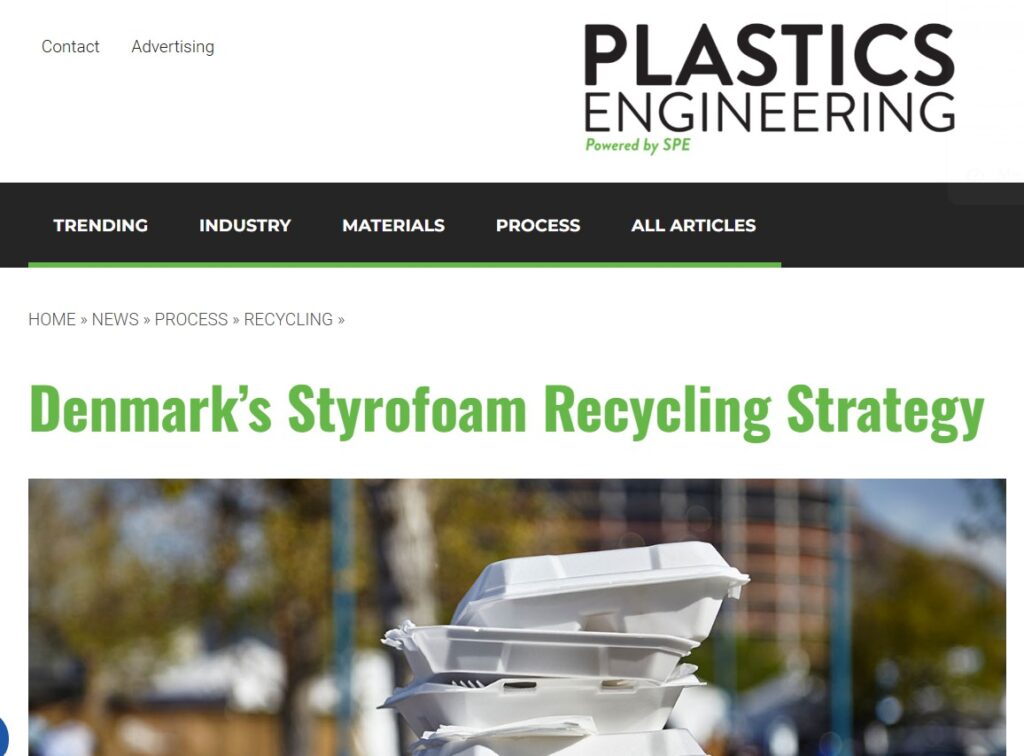
“Denmark’s Styrofoam Recycling Strategy” — Plastics Engineering, 17 Sept 2024 (plasticsengineering.org)