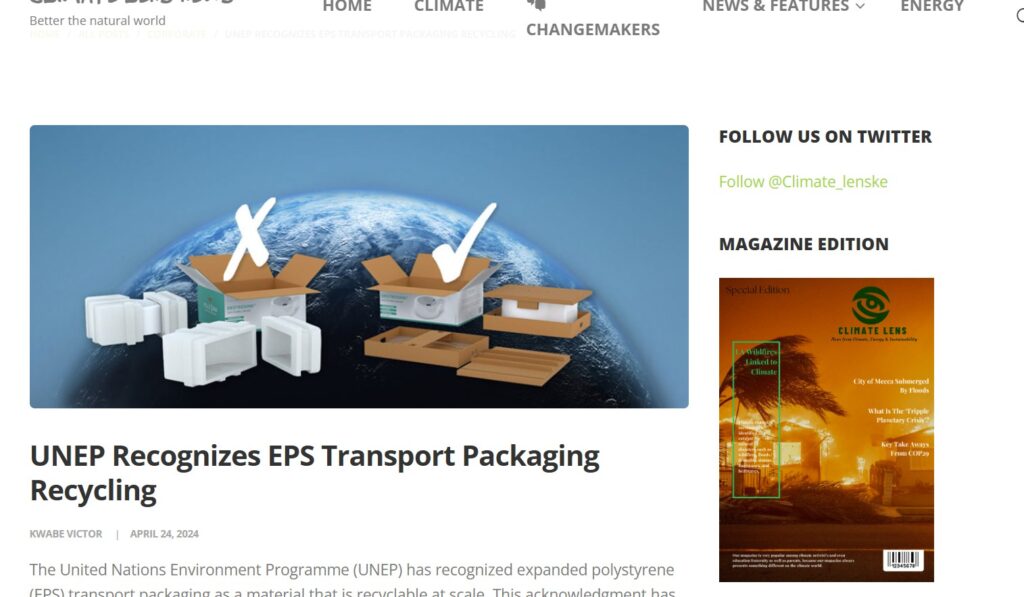
On 24 April 2024, the United Nations Environment Programme (UNEP) formally recognised Expanded Polystyrene (EPS) transport packaging — such as fish boxes and protective packaging — as a format that is “recyclable at scale.” This distinction appears in UNEP’s updated plastic pollution science report, prepared ahead of the INC‑4 global plastics treaty negotiations. (climate.co.ke)
UNEP emphasizes that recyclability differs by format and context. The report notes that only a few packaging formats — EPS transport packaging included — have been demonstrated to be recycled effectively and at scale in specific countries and regions. (climate.co.ke)
Acknowledging system-level nuance
Betsy Bowers of GESA (Global EPS Sustainability Alliance/EPS Industry Alliance) welcomed UNEP’s update, highlighting its alignment with a science-based rather than blanket-polymer approach. According to Bowers, the recognition underscores how packaging formats must be evaluated individually — taking into account technologies, contamination risk, and regulatory frameworks. (climate.co.ke)
UNEP’s revised report includes over 70 new or updated references, reflecting input from observers and serving as a technical foundation for the OCCURRENCE of INC‑4 treaty discussions. EPS transport packaging is explicitly cited as one of the few foam formats with proven, large-scale recycling performance. (climate.co.ke)
Sector example ahead of policy negotiations
UNEP’s distinction is timely. It demonstrates that beyond polymers, packaging formats require targeted evaluation— and EPS transport packaging meets that bar. This validation supports GESA’s call for:
- Extended Producer Responsibility (EPR) frameworks
- Quantitative thresholds (like volume-based targets)
- Life-cycle assessment for policy design (climate.co.ke)
Chresten Heide-Anderson from EPSbranchen (EUMEPS) echoed this, advocating for “science-based tools such as life cycle analysis” and the prioritisation of data-driven decision-making in the INC‑4 treaty process. (climate.co.ke)
Framing EPS as circular by evidence
By highlighting EPS transport packaging’s proven recyclability, UNEP offers a template for policymakers: do not generalise by material — evaluate by application. This distinction aids in rational policy formation, supports EPR alignment, and provides manufacturers, waste processors, and international bodies a clearer roadmap to treat EPS as circular — where performance is verified.
FACT BOX
| Item | Detail |
| Publication date | 24 April 2024 |
| System type | International policy recognition |
| Product format | EPS transport packaging (e.g., fish boxes) |
| Key finding | Recognised recyclable at scale |
| Report context | UNEP plastic pollution science report, INC‑4 prep |
| Key advocates | UNEP; GESA/EPS‑IA; EPSbranchen/EUMEPS |
| Policy relevance | Supports format-based EPR, data-driven frameworks |
📎 Source:
“UNEP Recognizes EPS Transport Packaging Recycling” — Climate Lens News, 24 April 2024
[https://climate.co.ke/unep-recognizes-eps-transport-packaging-recycling/]