In 2023, Montréal-based cleantech firm Polystyvert announced the construction of Canada’s first commercial-scale polystyrene (EPS) recycling plant, marking a major milestone in North American plastics recovery systems (polystyvert.com).
Located near Montréal, the CA $40 million facility will process an estimated 9,000 tonnes per year of post-consumer and post-industrial polystyrene waste—equivalent to roughly 15% of Québec’s annual polystyrene landfill stream (Recycling International). Polystyvert’s technology uses a low-temperature solvent-based purification (dissolution) process that removes contaminants and produces recycled resin identical in quality to virgin material, while reducing greenhouse gas emissions by up to 90% (Recycling International).
System and Technology Overview
Polystyvert’s dissolution recycling system handles a mix of EPS waste:
- EPS is dissolved in a solvent, separating it from contaminants, which are filtered out in multiple stages.
- Purification and precipitation steps recover pure polystyrene resin.
- The result is a food-grade resin that meets the specifications of virgin EPS and ABS (newswire.ca).
- The model is energy-efficient and scalable, designed for replication and licensing in other jurisdictions .
Strategic Relevance: Turning Policy into Practice
This plant is more than a technical prototype—it represents a functioning, scalable loop for EPS recycling in Canada:
- System scale-up: It transitions EPS recovery beyond small pilot schemes into industrial capacity.
- Government and private backing: It follows a CA $16 million Series B investment, combined with federal and provincial grants .
- Resilient output: The recycled resin has the same physical and chemical characteristics as virgin EPS—enabling direct reuse, even in sensitive applications (polystyvert.com).
- Climate impact: Capturing 9,000 t/year and lowering emissions by up to 90% shows how industrial recycling can be climate-effective.
This development demonstrates that EPS recycling is an industrial reality—not a niche experiment. Canada’s first commercial-scale plant shows that once infrastructure, regulation, and investment align, EPS can be fully integrated into circular material systems.
FACT BOX
| Item | Value |
| Developer | Polystyvert (soon to rebrand as UpSolv) |
| Location | Near Montréal, Québec |
| Capacity | 9,000 tonnes/year (≈15% of Québec EPS landfill stream) |
| Technology | Solvent-based dissolution & purification |
| Capital investment | CA $40 million (private + public funding) |
| Emission saving | Up to 90% GHG reduction compared to virgin resin production |
| Feedstock types | Post-consumer and post-industrial EPS, including contaminated material |
| Output quality | Food-grade EPS/ABS resin with virgin-equivalent properties |
| Scaling model | Commercial operation + licensing strategy |
Source:
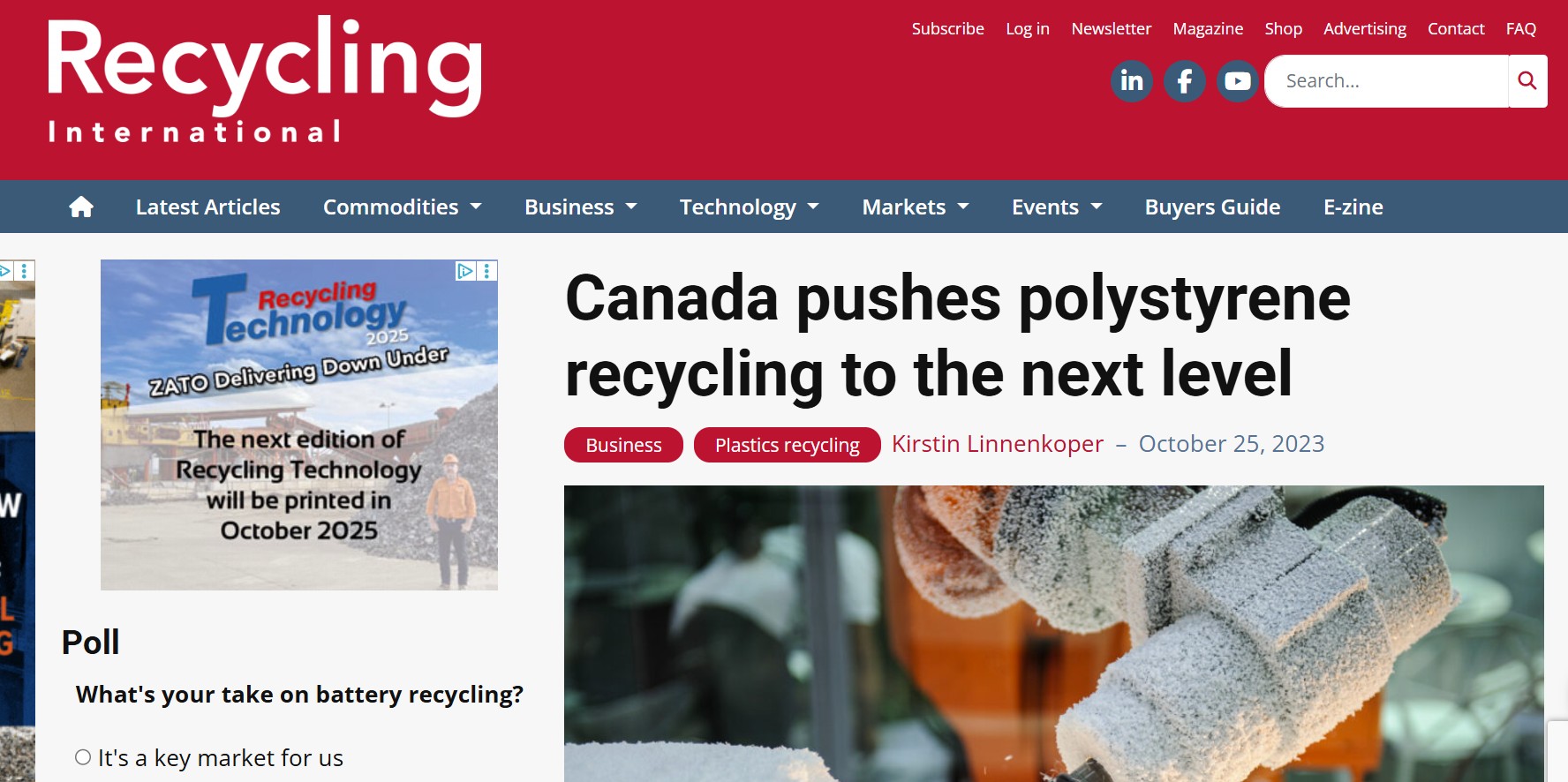
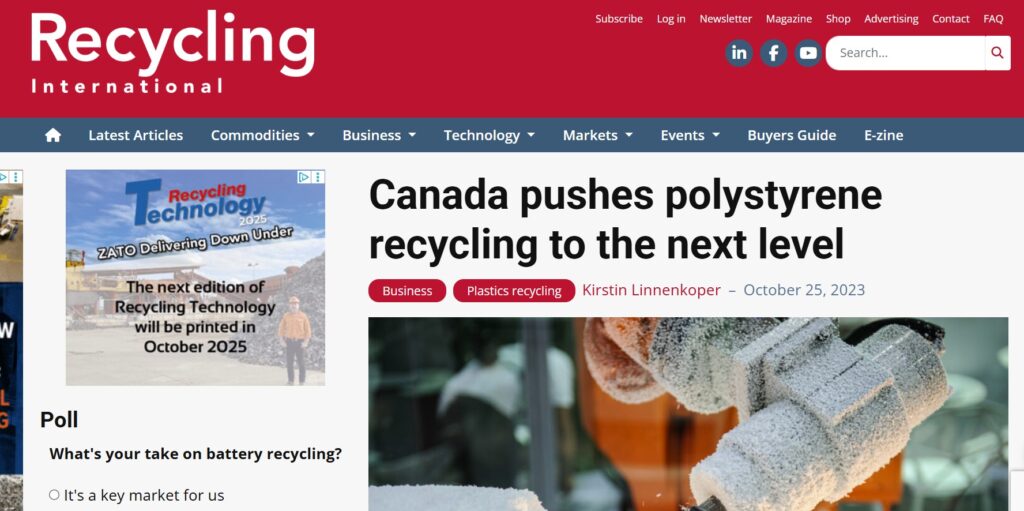
“Canada pushes polystyrene recycling to the next level” — Recycling International, October 25, 2023. (polystyvert.com, Recycling Today, Resource-Recycling, polystyvert.com, Recycling International)