
In Ringkøbing-Skjern Municipality, smarter material handling is reducing emissions and truck trips — thanks in part to the inclusion of expanded polystyrene (EPS) in the area’s recycling strategy.
In a public update issued in July 2024, the municipality confirmed that its compaction and sorting systems are lowering the number of trucks required to move waste and recyclable materials. EPS plays a key role in this shift due to its lightweight structure and high compressibility.
EPS reduces truck movements
EPS, often used for protective packaging and insulation, has long posed challenges due to its volume-to-weight ratio. However, with the right compaction equipment, EPS can be densified by up to 50:1, dramatically reducing its volume and allowing it to be transported more efficiently.
In Ringkøbing-Skjern, the integration of EPS into the compacted material stream has directly contributed to fewer lorry trips — one of several efforts the municipality is making to reduce its environmental footprint while increasing recycling efficiency.
The municipality’s communication highlights this principle in practice:
“The more compact the materials we move, the fewer resources we use to move them.”
— Ringkøbing-Skjern Kommune
Structural relevance: EPS and logistics logic
EPS’s transport efficiency is often overlooked in public waste narratives, but it remains a key enabler in cutting transport emissions within recycling and recovery systems. Its unique material properties mean that when densified, EPS no longer requires frequent pickup or large-volume transport — and becomes a viable stream for resale or downstream recycling.
The case shows:
- System gains from material-specific design: EPS is handled in ways that maximise payload and route optimisation.
- Climate gains through fewer lorry trips: Truck kilometres are reduced, lowering Scope 3 emissions across waste and recycling logistics.
- Operational alignment: Compacted EPS is now part of the municipality’s broader logic of resource- and climate-smart transport.
By demonstrating how volume reduction through EPS compaction supports system-wide transport savings, Ringkøbing-Skjern adds a tangible example to the Nordic circular economy playbook — where logistics, emissions, and material logic are addressed together.
Source:
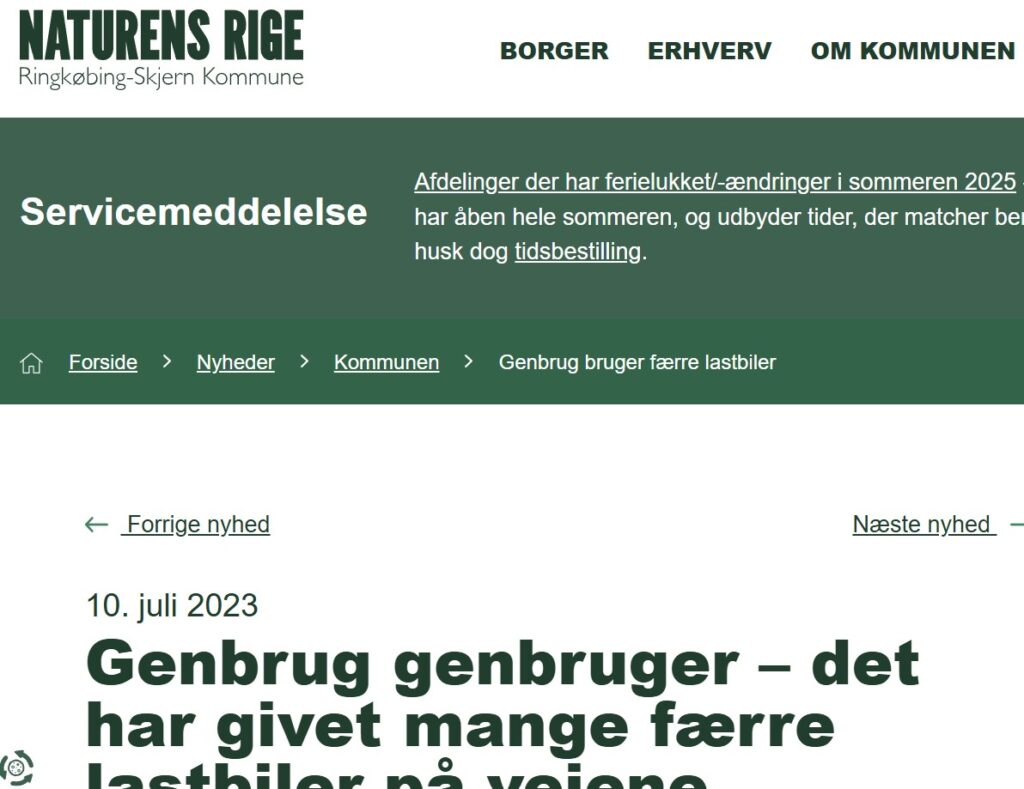
“Genbrug bruger færre lastbiler,” Ringkøbing-Skjern Kommune, July 2024
https://www.rksk.dk/nyheder/kommunen/juli/genbrug-bruger-faerre-lastbiler