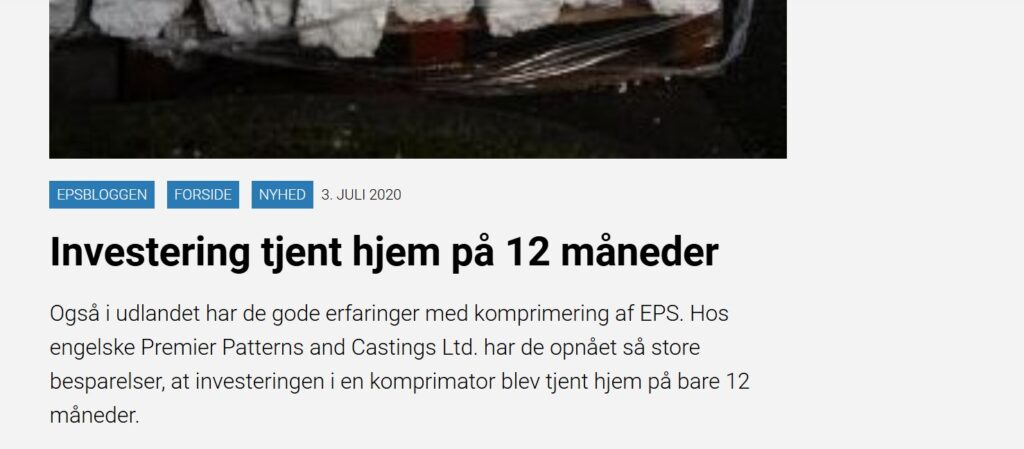
In Skive, Denmark, the municipal recycling centre installed an EPS densifier in 2020—a move that quickly proved financially sound. With support from EPS‑branchen and local stakeholders, the equipment paid for itself within 12 months through savings in transport and revenue from compressed EPS sales.
Investment and payback dynamics
Lightweight, bulky EPS often makes transport inefficient. Skive’s centre installed a standard densification unit, which reduced material volume by 98%, consolidating foam into dense blocks. This shift allowed weekly shipments on just a few pallets instead of frequent, low-load runs to recyclers.
Cost savings from reduced collection frequency, combined with income from selling recycled EPS blocks, allowed the centre to recoup the investment within a year. The facility manager reported it “took around 12 months for the added earnings and saved logistics costs to cover the purchase price” (~)
System mechanics
- Collection: Households and businesses bring clean EPS to the municipal centre.
- Compression: Densifier reduces volume approximately 50–70×.
- Transport: Palletised blocks are shipped weekly to recyclers.
- Financial model: Reduced collection runs + material sales offset equipment and operational costs.
This approach ensures traceable material flows and financial autonomy, turning EPS from low-value waste to a revenue stream supporting infrastructure.
Strategic relevance
Skive’s example offers a scalable blueprint: densification technology is now accessible to municipal recycling systems, reducing long-distance transport costs and revenue loss. When combined with modest resale revenue, the investment becomes self-supporting in about a year.
For municipalities weighing environmental infrastructure upgrades, this case provides concrete financial data: the capital outlay for equipment can become cost-neutral through logistics savings and commercial returns, supporting more resilient local circular systems.
Conclusion
The Skive municipal centre’s densifier paid for itself in just 12 months—demonstrating densification infrastructure is not only environmentally effective, but commercially viable. The case outlines a practical model for municipalities to enhance EPS circularity while minimizing operational costs.
Source: “Investering tjent hjem på 12 måneder,” EPS‑Airpop, July 2020 — EPS‑Airpop