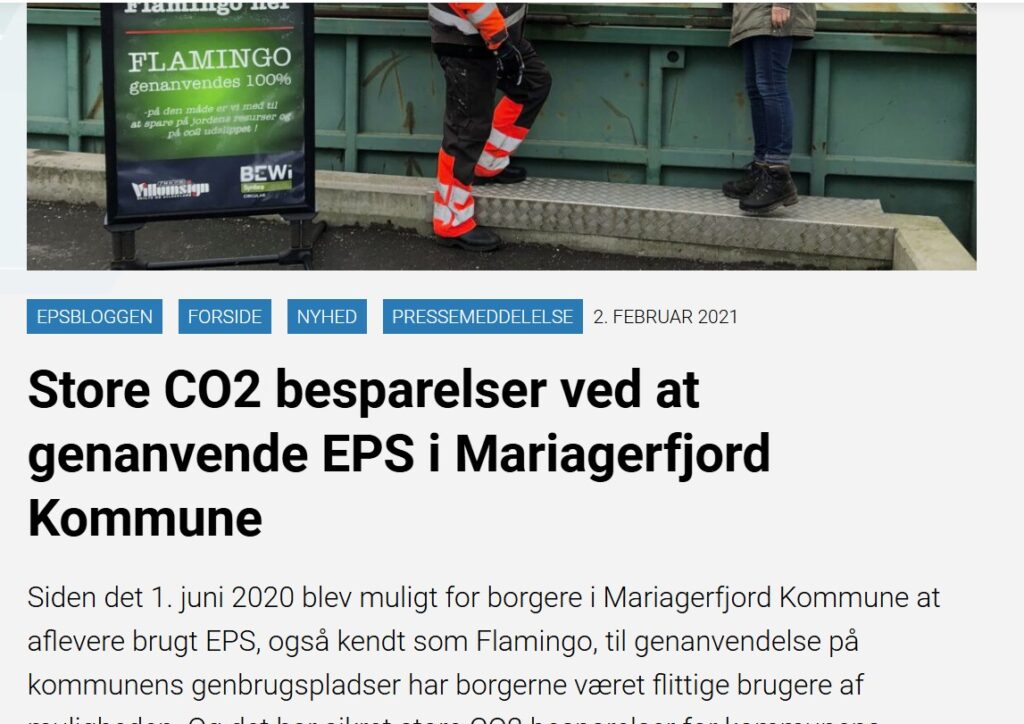
In June 2020, Mariagerfjord Municipality introduced EPS (“flamingo”) collection at its five recycling centres—covering Hobro, Hadsund, Als, Arden, and Mariager. Within just six months, residents returned 9.12 tonnes of used EPS—an average of 0.44 kg per resident—diverting material from incineration to recycling. (eps-airpop.dk)
System overview and logistics
Municipal recycling stations accepted clean, dry EPS that was then compressed on site to reduce volume. Once consolidated, the material was transported to BEWiSynbra Circular’s remelting facility in Thisted. There, it was processed into pellets and reintegrated into EPS production—a closed-loop system that maintained material value.
Climate and transport benefits
The compressed volume corresponded to roughly 6,600 m³—material that would otherwise require 220 truckloads to be incinerated. By recycling this EPS, the municipality saved about 81 tonnes of CO₂ annually—the equivalent of emissions from nearly five residents. The savings result from avoiding incineration emissions and reducing transport needs. (Leverandører, Nyheder og Viden)
Strategic relevance
This case demonstrates how publicly available EPS collection infrastructures can efficiently catalyse material recovery and emissions reduction. By combining source separation, volume reduction, and local recycling partnerships, Mariagerfjord achieved significant gains using existing municipal assets.
It also highlights the value of redirecting lightweight municipal waste streams: even small per-capita EPS volumes—when aggregated—deliver large gains in logistics and climate impact. Integrating EPS alongside other household-like waste expands municipal recycling scope without additional collection networks.
The municipality’s model offers a template for regional recycling authorities across Europe: accessible drop-off, onsite compaction, and closed-loop processing deliver measurable resource and emissions outcomes with modest infrastructure investment.
Conclusion
Mariagerfjord Municipality’s EPS recycling initiative achieved substantial environmental and logistical efficiency within months. With more than 9 tonnes recovered, approximately 81 t CO₂ saved, and 220 truckloads of waste avoided, the case demonstrates how municipal systems can drive EPS circularity through straightforward measures—adding up to outsized environmental impact.