A newly published study commissioned by the Danish Environmental Protection Agency has found that collecting and compacting expanded polystyrene (EPS) at municipal reuse stations may yield measurable environmental benefits compared to incineration.
The study, carried out by Rambøll, compares two handling scenarios: incinerating EPS with residual waste, or collecting it separately for compaction and recycling. While EPS is still often treated as a residual waste material, the findings suggest that it can be integrated into resource recovery systems with net positive effects.
Modelling municipal systems
The report is based on a model scenario representing a typical Danish recycling station. Here, approximately 15 tonnes of clean EPS would be collected annually. Instead of being sent to incineration, the EPS would be compacted on-site and sold to recyclers.
The study does not publish full data tables in the summary article, but it is stated that both environmental and economic effects were included in the modelling — such as transport, energy use, emissions, and material values.
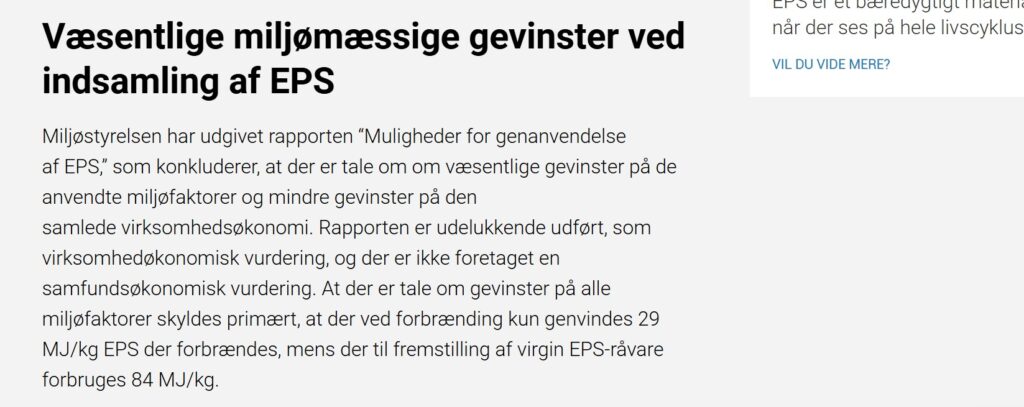
According to the article, the model shows that separate collection and compaction of EPS leads to a lower environmental burden than incineration, even after factoring in additional handling and transport.
Strategic context
While EPS is not widely collected for recycling in Denmark in 2003, this study marks an important step in evaluating how it can be managed as part of a circular material flow. The analysis is intended to help municipalities decide whether to introduce separate collection of EPS at their local reuse stations.
The article notes that the findings are based on conservative assumptions and representative volumes. It also emphasizes that compacted EPS has a market value when sold to recyclers, which may help offset the operational costs of collection and handling.
The study does not draw universal conclusions, but it provides municipalities with a data-supported argument for integrating EPS into their material management strategies where appropriate.
📌 FACT BOX
| Item | Value |
| Year of study | 2003 |
| Published by | EPS-Airpop.dk |
| Commissioned by | Danish Environmental Protection Agency (Miljøstyrelsen) |
| Assessment by | Rambøll |
| Facility modelled | Municipal reuse station |
| EPS volume (model) | ~15 tonnes per year |
| Processing method | Separate collection + on-site compaction |
| Comparative scenario | Incineration |
| Outcome | Lower environmental impact from EPS recycling |
📎 Source: “Væsentlige miljømæssige gevinster ved indsamling af EPS” – EPS-Airpop.dk (23 May 2003)